Skill Acquisition: How Skills Develop, Stages and How to Speed It Up

What is skill acquisition?
Skill acquisition is the goal-directed cognitive and biological process through which practice transforms a slow, error-prone, and conscious action into a faster, more accurate, and largely automated performance. While declarative learning focuses on acquiring facts and semantic propositions (knowing that), skill acquisition focuses on procedural competence: knowing how to execute an operation smoothly under real-world constraints.
In cognitive science and motor behavior, skill development is evaluated across four operational dimensions: speed, reflecting the reduction in reaction latency and execution time; accuracy, measuring the systematic elimination of mechanical, tactical, or syntactic errors; consistency, denoting the capacity to reproduce high-level execution across varying environmental stresses; and automaticity, the progressive freeing of central working memory, which allows the practitioner to execute core mechanics with minimal conscious oversight while attending to higher-order strategic decisions.
At the neural level, John Anderson’s ACT-R theory (1982) demonstrates that skill learning involves a fundamental knowledge compilation shift. Learners begin in the declarative stage, relying on conscious verbal rules held in working memory (such as “keep the wrist firm” or “indent four spaces”). Through extensive practice and overlearning (Myers & Fisk, 1987), declarative rules are compiled into procedural productions—automated neural circuits stored in the motor cortex, basal ganglia, and cerebellum. This automated neuromuscular execution is commonly referred to as muscle memory. While specific motor and perceptual demands vary widely, cognitive, motor, perceptual, and social proficiencies follow shared developmental dynamics; reviewing the full taxonomy across types of skills details how these domain mechanics diverge.
How do skills develop?
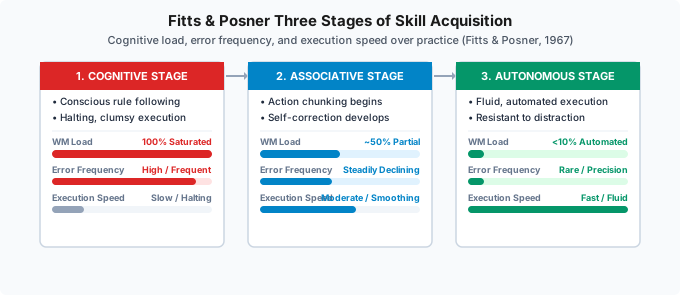
In their classic framework, Paul Fitts and Michael Posner (1967) established that skill progression moves through three distinct phases: the cognitive stage, where working memory is saturated by conscious rule-following and halting movements; the associative stage, where individual movements compile into chunks, errors decline, and self-correction develops; and the autonomous stage, where performance becomes fluid and automated, requiring minimal working-memory capacity.
Complementing this progression, Stuart and Hubert Dreyfus (1980) developed a five-stage model tracing qualitative shifts in perception and decision-making: from the rule-bound Novice and situational Advanced Beginner, to the planning Competent learner, the intuitive Proficient practitioner, and the fluid, holistic Expert. Crucially, the Dreyfus model emphasizes that teaching methods must shift as learners advance: imposing rigid explicit rules on proficient performers disrupts intuitive flow, while withholding explicit structure from novices causes cognitive paralysis. Examining these transitions across the stages of skill acquisition clarifies how pedagogical requirements evolve.
Phillip Ackerman’s theory of individual differences (1988) further demonstrates that the cognitive abilities predicting performance shift across time: general intelligence (Gf) predicts success during the early cognitive phase, perceptual speed governs the associative phase, and psychomotor abilities dictate autonomous motor execution.
Why does progress slow down over time?

A universal feature of skill acquisition is that learning curves are non-linear. In 1981, Allen Newell and Paul Rosenbloom formalized the Power Law of Practice, proving across hundreds of experimental tasks that the time required to complete an operation decreases as a power function of practice trials.
Early in training, learners make massive leaps in speed and error reduction as they eliminate gross mistakes and grasp fundamental relationships. As training continues, the mathematical derivative flattens: each additional percentage gain in performance requires exponentially more practice investment. Understanding the mathematical dynamics of the learning curve prevents learners from mistaking natural mathematical deceleration for personal failure.
When progress completely halts, the performer has entered a learning plateau. Plateaus typically occur when early novice methods hit architectural ceilings, or when practice becomes comfortable and automated. Without deliberate intervention, automated routines stagnate. Furthermore, when training ceases, memory engrams experience skill decay, requiring structured overlearning and periodic refresher drills to preserve neural circuitry.
What practice conditions make skill acquisition effective?

The popular maxim that “practice makes perfect” is scientifically inaccurate. Mere repetition on autopilot simply cements existing habits without producing improvement. To prevent stagnation, learners must distinguish between naive vs deliberate practice: naive practice involves mindless repetition, whereas deliberate practice involves focused training targeting specific micro-weaknesses under expert guidance.
Research identifies five empirical practice conditions that accelerate skill acquisition:
- Informative Task Feedback: Practice without precise error signals reinforces mechanical flaws. Salmoni, Schmidt, and Walter (1984) established that knowledge of results (KR) and knowledge of performance (KP) are essential for motor adaptation. As detailed in our review of feedback, explanatory feedback that highlights why an error occurred accelerates mastery far more than unguided trial and error.
- Variable Practice & Contextual Interference: Blocked drilling (repeating the exact same stroke or calculation 50 times in a row) produces rapid short-term performance but poor long-term retention. By contrast, deploying variable practice by mixing movement speeds, angles, or problem types forces the brain to reconstruct motor programs on every trial, driving superior delayed transfer.
- Calibrated Practice Duration: Cognitive and neuromuscular fatigue degrades practice quality. Limiting high-intensity deliberate drills to 45–60 minute sessions optimizes practice duration and protects focus.
- Mental Practice and Motor Imagery: Neuroimaging reveals that mental simulation activates the premotor cortex, supplementary motor areas, and basal ganglia. Integrating mental practice alongside physical execution enhances neuromuscular coordination.
- Distributed Spaced Scheduling: Distributing training sessions across days (Donovan & Radosevich, 1999) enables offline synaptic consolidation during sleep, outperforming massed marathon sessions.
How do you speed up skill acquisition?
Accelerating skill development requires moving beyond passive repetition and adopting an engineered training methodology:
- Task Deconstruction: Complex competencies hide multiple interwoven components. As Susan Ambrose and colleagues (2010) highlight, instructors and self-learners must decompose complex skills into manageable sub-skills, drilling rate-limiting bottlenecks independently before recombining them into an integrated whole.
- Dual-Track Training: Effective programs cultivate two simultaneous tracks: routine expertise (automating component skills for speed and efficiency) and adaptive expertise (cultivating flexibility, conceptual reflection, and variation to solve novel, unscripted problems).
- Designing for Transfer: Training should incorporate transfer-appropriate processing. Maximizing the transfer of learning requires practicing in authentic, job-realistic environments with varied surface features.
- Structured Deliberate Routines: Following an explicit, evidence-based deliberate practice method ensures every training hour targets measurable stretch goals with rapid feedback.
To master an end-to-end curriculum designed to accelerate your acquisition of physical, technical, and professional crafts, explore The Skill Acquisition System.
How do skills relate to expertise?
While the terms are often used interchangeably in casual conversation, cognitive psychology draws a sharp functional distinction between possessing a skill and possessing expertise.
A skill is a modular functional building block—such as touch typing at 80 words per minute, executing a clean tennis serve, or writing a SQL query. Expertise, by contrast, represents the holistic orchestration of tens of thousands of integrated skills, domain-specific schemas, and mental representations. As examined in our comprehensive synthesis of expertise such as skill acquisition, an expert does not merely execute sub-skills faster; their entire perceptual and cognitive architecture is rewired to perceive deep situational patterns that novices cannot see.
Is talent or practice more important?
One of the fiercest debates in modern psychology concerns the relative contribution of innate biological talent versus structured practice in determining ultimate performance.
In 1993, K. Anders Ericsson and colleagues proposed the deliberate practice framework, arguing that elite performance is primarily the product of accumulated hours of highly structured, effortful practice rather than innate genetic gifts. However, a major meta-analysis by Macnamara, Hambrick, and Oswald (2014) reanalyzed the empirical literature across games, music, sports, education, and professions. Their findings revealed that while deliberate practice explains a massive portion of performance variance in highly predictable, rule-bound domains (such as games like chess: $26%$, and music: $21%$), it explains significantly less variance in less structured professional domains ($1%$).
Furthermore, research has thoroughly dismantled the popularized belief in a universal 10,000-hour rule: practice hours vary widely across individuals, and time investment alone does not guarantee elite achievement. Ultimately, skill acquisition reflects an intricate interaction between biological predispositions and environmental cultivation, but deliberate practice remains the single operational variable within the learner’s direct control.
References & Scientific Evidence
- (1967).Human Performance.
- (1982).Acquisition of cognitive skill.
- (1980).A Five-Stage Model of the Mental Activities Involved in Directed Skill Acquisition.
- (1988).Determinants of individual differences during skill acquisition: Cognitive abilities and information processing.
- (1981).Mechanisms of skill acquisition and the law of practice.
- (1993).The role of deliberate practice in the acquisition of expert performance.
- (2014).Deliberate practice and performance in music, games, sports, education, and professions: A meta-analysis.
- (1984).Knowledge of results and motor learning: A review and critical reappraisal.
- (1999).A meta-analytic review of the distribution of practice effect: Now you see it, now you don't.
- (2010).How Learning Works: Seven Research-Based Principles for Smart Teaching.