Feedback for Skill Development: Types, Timing and How to Get Useful Feedback

What is feedback in learning?
In cognitive science and educational psychology, feedback is defined as information provided by an external agent (such as a teacher, coach, peer, measurement instrument, or self-monitoring system) regarding aspects of one’s performance or understanding relative to an intended goal. Rather than serving as a terminal judgment or punitive grade, effective feedback functions as an informational bridge: it diagnoses the discrepancy between current execution and the desired standard, providing actionable cues to guide the next attempt.
In their influential conceptual framework, John Hattie and Helen Timperley (2007) established that effective instructional feedback must address three fundamental questions:
- “Where am I going?” (Feed Up): Clarifying the explicit goal, success criteria, and objective benchmarks of performance.
- “How am I going?” (Feed Back): Providing diagnostic evaluation of current performance relative to those standards.
- “Where to next?” (Feed Forward): Offering concrete, actionable recommendations for subsequent trials to bridge the performance gap.
Hattie and Timperley categorized feedback across four distinct operational levels:
- Task level (FT): Information about how well a specific task is performed (e.g., distinguishing whether an answer is correct or incorrect).
- Process level (FP): Information about the underlying mechanisms, strategies, cognitive relationships, and procedural steps needed to execute the task.
- Self-regulation level (FR): Information that prompts metacognitive monitoring, self-evaluation, and strategic adjustment of one’s own learning behaviors.
- Self level (FS): Personal evaluations or praise directed at the learner as an individual (e.g., “You are so smart!”), which contains no diagnostic information.
Does feedback improve learning?
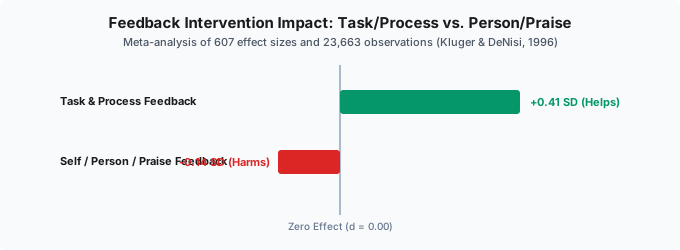
Across hundreds of empirical trials, the overarching finding is unequivocal: on average, feedback accelerates learning and enhances performance. However, its effectiveness is among the most variable of all educational interventions.
In a landmark meta-analysis synthesizing 607 effect sizes across 23,663 observations, Avraham Kluger and Angelo DeNisi (1996) reported a moderate average positive effect size of $d = 0.41$. Subsequent comprehensive syntheses have reinforced this baseline benefit, with Hattie and Timperley (2007) reporting an average effect of $d = 0.79$ and Wisniewski, Zierer, and Hattie (2020) finding $d = 0.48$ across 435 educational studies.
The Double-Edged Sword of Feedback
The most critical revelation of modern feedback research is that feedback is fundamentally a double-edged sword. In Kluger and DeNisi’s (1996) synthesis, over 38% of feedback interventions actually produced worse performance than no-feedback control conditions.
According to Feedback Intervention Theory (FIT; Kluger & DeNisi, 1998), feedback alters how learners allocate limited attentional and working memory resources. When feedback focuses on task mechanisms or strategies, it redirects effort toward productive error elimination. Conversely, when feedback is ambiguous, punitive, public, or perceived as an ego threat, attention is diverted away from the task and toward self-defense, anxiety, and impression management, severely degrading cognitive performance.
What types of feedback are there?
The magnitude of skill improvement depends profoundly on the structural format of the feedback provided. Comprehensive meta-analyses establish a clear hierarchy of feedback types:
1. Elaborated Feedback ($d = 0.49$) vs. Bare Knowledge ($d = 0.05$)
In a meta-analysis of computer-based learning environments, Van der Kleij, Feskens, and Eggen (2015) compared three distinct feedback formats:
- Knowledge of Results (KR): Merely informing the learner whether their response was correct or incorrect yielded a negligible effect size of $d = 0.05$.
- Knowledge of Correct Response (KCR): Revealing the correct answer produced a moderate effect size of $d = 0.32$.
- Elaborated Feedback (EF): Providing conceptual explanations, diagnostic error rationales, and guiding principles generated the largest effect size at $d = 0.49$.
Elaborated feedback forces the learner to repair faulty internal schemas, whereas bare confirmation of correctness allows learners to guess or memorize answers without understanding underlying principles.
2. Process and Strategy Feedback vs. Person-Directed Praise
Meta-analyses in educational and physical education settings (Han et al., 2022; Wisniewski et al., 2020) demonstrate that feedback targeting the process (e.g., “Adjusting your elbow angle will stabilize your follow-through”) generates substantial skill improvements, whereas praise directed at the self (e.g., “Good job, you are a natural”) produces near-zero or negative learning effects ($d \approx 0.12$ or lower).
| Feedback Category | Focus & Example | Empirical Effect Size | Learning Mechanism |
|---|---|---|---|
| Elaborated / Explanatory | Process & strategy: “Your conclusion lacks causal evidence; review the control group data.” | $d \approx 0.49$ (High) | Repairs cognitive representations and deepens conceptual understanding. |
| Knowledge of Correct Response | Correct output: “The answer is 42.” | $d \approx 0.32$ (Moderate) | Allows direct error correction, but provides minimal conceptual transfer. |
| Knowledge of Results (KR) | Binary outcome: “Correct / Incorrect” | $d \approx 0.05$ (Negligible) | Fails to diagnose why the error occurred; induces guessing. |
| Person-Directed Praise | Personal trait: “You are brilliant at math!” | $d \approx 0.12$ (Weak / Risky) | Triggers self-focus and risk aversion; increases vulnerability when tasks fail. |
When should you get feedback?
Determining the optimal timing of feedback is governed by what motor learning and cognitive scientists call the guidance hypothesis (Salmoni, Schmidt, & Walter, 1984).
The Guidance Hypothesis in Skill Acquisition
In motor, procedural, and clinical skills, receiving immediate, continuous feedback during task execution (concurrent feedback) leads to rapid performance gains during practice. However, empirical studies reveal a severe hidden cost:
- In a meta-analysis of augmented motor feedback, Mon-López et al. (2021) found that while augmented feedback improved execution during initial practice ($ES = 0.87$), abruptly removing that feedback during retention tests caused performance to plunge ($ES = -0.74$).
- When learners receive continuous external cues (such as visual displays or auditory prompts), the feedback acts as a cognitive crutch. Learners rely on the external cue rather than processing their own intrinsic somatosensory signals or developing internal error-detection mechanisms.
Optimal Feedback Scheduling
To avoid dependency while maximizing long-term retention and transfer, evidence-based training protocols recommend:
- Terminal Feedback: In simulation and procedural training, Hatala et al. (2014, 2016) showed that providing feedback after a trial is completed ($ES = 0.74$) leads to superior delayed retention compared to interrupting learners during execution.
- Faded Feedback Schedule: Providing frequent feedback during early stages of skill acquisition, then systematically reducing feedback frequency as proficiency increases.
- Learner-Controlled Feedback: A 2025 meta-analysis by Wang et al. (29 studies, 1,147 participants) demonstrated that allowing learners to choose when they receive feedback significantly enhances delayed retention and transfer compared to instructor-scheduled feedback, because learners request feedback precisely when they detect internal uncertainty.
Integrating these timing principles into a structured routine is central to building a sustainable deliberate practice plan.
How do you get useful feedback?
In real-world professional, academic, and creative environments, high-quality, actionable feedback is rarely handed out automatically. Achieving rapid skill acquisition requires developing proactive feedback literacy—the capacity to elicit, interpret, and implement constructive information (Malecka, Boud, & Carless, 2024).
To secure high-yield feedback from mentors, peers, or objective systems:
- Ask Specific Diagnostic Questions: Never ask general questions like “How did I do?” Instead, direct your reviewer’s attention to specific performance parameters: “Did my introductory thesis clearly establish the causal mechanism, or was the transition abrupt?”
- Provide Explicit Objective Rubrics: Ground evaluations in standardized criteria rather than subjective impressions. In professional clinical audits, Hysong (2009) and Ivers et al. (2012) found that feedback effectiveness doubles when accompanied by written action plans and concrete improvement benchmarks.
- Build an Educational Alliance: Medical education research by Burgess et al. (2023) demonstrates that feedback is most effective when embedded in an “educational alliance”—a collaborative partnership where the learner explicitly welcomes critique and the mentor provides psychologically safe, non-punitive guidance. Learning alongside experienced practitioners is detailed in our guide on mentorship and expertise.
- Leverage Simulation and Objective Data: In clinical medicine, surgical training, and aviation, feedback-integrated simulation incorporating automated manikin metrics and video debriefing improves clinical performance by 16% and sustains procedural competency for up to 12 months without decay (First-Year Simulation Collaborative, 2019; Healthcare Simulation Translational Group, 2026).
How does feedback support self-regulation?
Feedback is not merely an external transmission of corrections; its ultimate evolutionary purpose is to calibrate the learner’s internal self-regulation mechanisms (Butler & Winne, 1995).
When self-regulated learners receive high-quality feedback, they compare the external information against their own internal monitoring judgments:
- Metacognitive Calibration: If an athlete or programmer believes their execution was flawless, but diagnostic feedback identifies an inefficiency, the discrepancy prompts a reassessment of their internal monitoring standards.
- Strategy Modification: Rather than increasing raw effort indiscriminately, feedback guides learners to abandon ineffective study techniques (such as passive re-reading) and adopt high-utility strategies (such as active retrieval and spacing).
- Embracing Productive Failure: High feedback literacy transforms errors from sources of shame into rich informational signals. To understand why initial missteps accelerate conceptual restructuring, explore how does failure help learning.
Is praise useful feedback?
In educational and skill development literature, person-focused praise is widely recognized as ineffective or actively harmful for skill acquisition.
While praise can provide temporary emotional validation, cognitive science identifies three major drawbacks:
- Zero Instructional Value: Telling a learner “You are brilliant” provides no information on what was done correctly or what specific adjustments should be made next.
- Fostering a Fixed Mindset: Praise directed at fixed traits encourages learners to attribute outcomes to innate ability. When tasks inevitably become difficult, learners interpret errors as evidence that they lack talent, inducing helplessness and avoidance of challenging tasks.
- Triggering Self-Threat: Kluger and DeNisi (1998) showed that person-focused comments draw attention toward the self and away from task details. This increases performance anxiety and social comparison, degrading working memory capacity during complex problem solving.
To support durable how skills develop, constructive praise should be strictly restricted to effort, strategy choice, and persistence—framing errors as natural, diagnostic opportunities on the path to mastery.
References & Scientific Evidence
- (1996).The effects of feedback interventions on performance: A historical review, a meta-analysis, and a preliminary feedback intervention theory.
- (1998).Feedback interventions: Toward the understanding of a double-edged sword.
- (2007).The power of feedback.
- (2020).The power of feedback revisited: A meta-analysis of educational feedback research.
- (2015).Effects of feedback in a computer-based learning environment on students' learning outcomes: A meta-analysis.
- (2011).Formative assessment: A meta-analysis and a call for research.
- (2009).Meta-analysis: Audit and feedback features impact effectiveness on care quality.
- (2012).Audit and feedback: Effects on professional practice and healthcare outcomes.
- (2021).Effectiveness of augmented feedback on motor skills: A meta-analysis.
- (2025).Self-controlled feedback and behavioral outcomes in motor skill learning: A meta-analysis.
- (2022).Feedback for promoting motor skill learning in physical education: A trial sequential meta-analysis.
- (2014).Feedback for simulation-based procedural skills training: A systematic review and meta-analysis.
- (2023).Feedback in medical education: An evidence-based guide to best practices from the Council of Residency Directors in Emergency Medicine.
- (2024).Can students’ feedback literacy be improved? A scoping review of educational interventions.
- (2018).The Cambridge Handbook of Instructional Feedback.