Self-Directed Learning: What It Is and How to Teach Yourself Anything

What is self-directed learning?
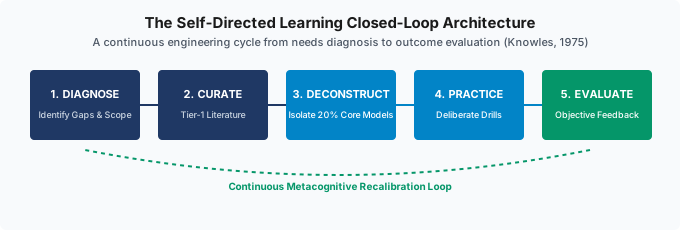
Self-directed learning (SDL) is an active, metacognitive process in which individuals take the primary initiative—with or without the guidance of mentors—in diagnosing their learning needs, formulating clear goals, identifying human and material resources, executing evidence-based cognitive strategies, and objectively evaluating their learning outcomes. First formalized within adult education by Malcolm Knowles in 1975, self-directed learning marks the decisive transition from passive educational compliance to sovereign cognitive agency.
As cognitive researchers Myriam Neelen and Paul Kirschner emphasize, self-direction is not merely “studying alone.” Rather, it is a deliberate self-governance architecture where the learner assumes executive responsibility for every phase of skill acquisition. In Ultralearning, Scott H. Young adds an essential structural clarification: self-direction is defined by who holds the decision-making authority regarding what to learn and why, not the physical setting where learning takes place. An individual attending a structured university lecture or working through a formal syllabus remains self-directed as long as they are actively steering their own intellectual project.
In his foundational treatises on autodidactic mastery, Peter Hollins points out that self-directed learners operate from intrinsic motivation and personal autonomy rather than external compulsion or fear of low grades. Whether mastering statistical modeling to build an open-source tool, learning biochemistry to solve a clinical puzzle, or studying ancient history out of deep intellectual curiosity, the drive originates within the learner.
Cognitive and educational psychologists distinguish between two complementary operational tiers of autonomous learning:
- Macro-Level Self-Directed Learning (SDL): The strategic, long-term educational trajectory governing which domain you choose to master, which primary textbooks and mentors you curate, and how you design your multi-month development roadmap.
- Micro-Level Self-Regulated Learning (SRL): The moment-by-moment regulation of cognition, motivation, and volition during a specific study block—such as detecting when working memory is overloaded, maintaining attention against distractions, and actively choosing between retrieval drills and worked-example analysis.
Self-directed learning is never an isolated or anti-social endeavor. True self-direction means taking full ownership of your intellectual destiny while actively curating the world’s best expert guidance, instructional resources, and peer feedback communities to accelerate durable competence.
How does self-directed learning work?
To explain how independent learners maintain cognitive focus and achieve durable mastery over months and years, educational psychologist Barry J. Zimmerman (2000, 2002) formulated a cyclical model of self-regulated learning. Rather than viewing self-direction as an innate personality trait, Zimmerman demonstrated that proficient autodidacts operate through three recurring, iterative phases:
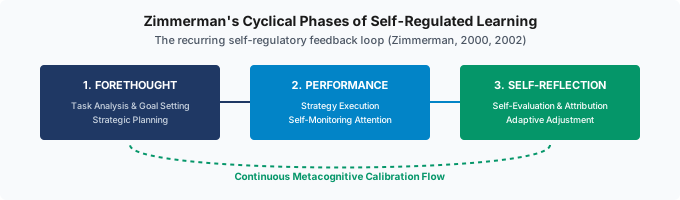
- The Forethought Phase: Precedes active study. The learner conducts task analysis, establishes proximal process goals, selects targeted cognitive strategies, and activates self-efficacy beliefs.
- The Performance Phase: Unfolds during active learning. The learner executes the chosen strategy while maintaining focused attention and monitoring comprehension. Crucially, they use metacognitive tracking to identify when working memory is overloaded or when comprehension falters.
- The Self-Reflection Phase: Occurs after the session or project milestone. The learner evaluates their execution against objective criteria, determines the causal reasons for any performance discrepancy (attribution), and adapts their strategy for the subsequent cycle.
In How Learning Works, Susan A. Ambrose and colleagues map this into a continuous 5-stage metacognitive cycle: Assess the task $\rightarrow$ Evaluate strengths and weaknesses $\rightarrow$ Plan the approach $\rightarrow$ Apply strategies $\rightarrow$ Reflect and adjust.
To operationalize Zimmerman’s model into rigorous daily practice, educational psychologists formulate concrete standard operating procedures (such as text comprehension SOPs):
- Self-Evaluation & Baseline Tracking: Logging quantitative metrics (e.g., minutes spent per page, main ideas extracted, lines highlighted versus original summary sentences generated) and calculating a calibrated Self-Efficacy Score (estimated score weighted by confidence certainty).
- Process Goals vs. Outcome Goals: Shifting from vague desires (“I will read harder”) to precise mechanical targets (“I will extract at least three main ideas per page and write one summary sentence per section”).
- Strategy Execution & Calibration Audits: Comparing self-efficacy predictions against objective test results and peer evaluations. When a learner predicts 90% confidence but scores 40%, they expose the “illusion of competence,” revealing that their study strategy failed to encode the knowledge into long-term memory.
By cycling through this feedback loop, learners transform ambitious educational intentions into an engineered routine for teaching yourself.
Does self-directed learning work?
The empirical literature confirming the effectiveness of self-directed and self-regulated learning interventions is extensive and replicated across academic, vocational, and digital environments:
- University Academic Performance: In a comprehensive meta-analysis of self-regulated learning interventions in higher education, Theobald (2021) synthesized 49 randomized controlled trials, establishing an overall positive effect size of $g = 0.37$ on academic performance. Interventions that combined cognitive strategies with metacognitive self-monitoring yielded the largest learning gains.
- Online and Remote Learning Environments: A meta-analysis by Chen and colleagues (2020) examining 30 experimental interventions in digital and distance education revealed a substantial positive effect ($g = 0.508$). In autonomous digital settings where teacher supervision is absent, self-regulation capabilities dictate whether a student completes a course or abandons it within the first two weeks.
- Adult Workplace and Vocational Training: In corporate training contexts, Sitzmann and Ely (2011) conducted a meta-analysis across 430 independent samples, finding that adult trainees who actively regulated their goal-setting and self-monitoring achieved substantially higher declarative knowledge ($d = 0.34$) and skill retention than passive participants.
- School-Age Interventions: Dignath and Büttner (2008) examined self-regulation training programs across primary and secondary schools, documenting robust effect sizes on academic achievement ($g = 0.69$ and $g = 0.40$, respectively).
The Novice Boundary: The Failure of Unguided Discovery
Cognitive science issues a vital boundary warning: self-direction is not synonymous with unguided discovery. In their seminal paper “Why Minimal Guidance During Instruction Does Not Work,” Paul Kirschner, John Sweller, and Richard Clark (2006) proved that forcing novice learners to “discover” complex concepts without structured guidance causes cognitive overload and severe misconceptions. A meta-analysis of 164 studies by Alfieri and colleagues (2011) confirmed that unguided discovery learning consistently produces inferior outcomes ($d = -0.38$) compared to explicit instructional models.
Proficient self-directed learners do not improvise facts from vacuum. Instead, they act as their own curriculum designers: when tackling a new subject, they deliberately seek out structured worked examples, direct expert explanations, and curated high-quality materials before attempting independent problem solving.
What skills do self-directed learners need?
Successful self-direction requires orchestrating a comprehensive cognitive and behavioral toolkit:
- SMART Goal Architecture: Goal-setting theory (Locke & Latham, 2002) proves that vague intentions produce poor persistence. As Peter Hollins emphasizes, effective self-learners anchor their studies in SMART goals (Specific, Measurable, Achievable, Relevant, and Time-based), mapping their milestones through a dedicated learning plan.
- Implementation Intentions: To prevent procrastination and cognitive friction, learners deploy Peter Gollwitzer’s implementation intentions framework ($d = 0.65$). Pre-committing to conditional rules—“If it is 7:00 AM on Monday, Wednesday, and Friday, then I will silence my phone and work on chapter 4 for 60 minutes”—automates the initiation of study blocks.
- Rigorous Resource Curation: Self-learners avoid the common trap of hoarding dozens of PDF textbooks they never finish. They evaluate and select authoritative, tier-1 primary sources, comparing courses, books, and expert mentors through structured criteria for learning resources, and mastering practical workflows for learning from books.
- Generative Learning Strategies: Learning is not a passive recording process; it is a generative activity where the learner actively constructs conceptual meaning. Educational researchers Logan Fiorella and Richard Mayer (Learning as a Generative Activity) identify two premier generative strategies:
- Self-Explaining: Pausing during study to explain why a principle is logically true and how it links to prior knowledge, repairing flawed mental models in real time.
- The Protégé Effect (Learning by Teaching): Explaining concepts aloud to an uninitiated peer or an imaginary student. Teaching forces the learner to organize material, eliminate lazy generalizations, and instantly identify conceptual gaps—a process detailed in our guide on the protege effect.
- Authentic Project Application: Rather than spending months trapped in passive theory, effective autodidacts test their comprehension by building functional projects under real-world constraints—a methodology explored in learning by doing.
- Social Feedback & Community Scaffolding: Autonomous learning thrives when paired with external accountability. Engaging with peers, study circles, and master practitioners provides the corrective feedback needed to avoid insular blind spots, as outlined in learning communities.
- Metacognitive Progress Audits: Logging objective data, tracking study metrics, and maintaining regular progress reviews prevents fluency illusions, providing actionable data through learning progress tracking.
How do you start?
Embarking on a complex self-directed learning journey requires transitioning from vague intellectual interest into an engineered operational sequence:
- Scope and Deconstruct the Domain: Identify the 20 percent of core mental models, governing principles, and invariant laws that control 80 percent of the field’s operational mechanics.
- Execute Intensive Deliberate Sprints: Rather than diluting study into sporadic, unfocused sessions, structure your project around high-intensity focus and aggressive direct practice, adopting the evidence-backed principles of ultralearning.
- Protect a Daily Deliberate Practice Block: Reserve an inviolable, distraction-free time window dedicated strictly to effortful problem solving and active recall.
- Schedule Objective Calibration Audits: Every two weeks, evaluate your true comprehension under closed-book conditions: solve unseen problem sets, build an unguided project, or explain the core concepts aloud without checking reference notes.
To access a complete, field-tested operating curriculum that guides you through deconstructing and mastering complex domains independently, explore our flagship self-learning program.
Why is self-directed learning more important in a changing world?
In previous industrial eras, formal academic degrees served as permanent licenses for lifelong careers. A professional could master a static body of knowledge in their early twenties and execute those skills until retirement. Today, technological acceleration, automation, and algorithmic intelligence render specialized domain knowledge obsolete at unprecedented speed.
In modern intellectual economies, the capability to independently acquire complex, unfamiliar domains is the ultimate meta-competency. Committing to lifelong learning is no longer an optional hobby; it is the fundamental requirement for economic relevance and personal sovereignty.
Furthermore, mastering learning in the age of AI such as self-directed learning introduces a profound cognitive paradox: generative artificial intelligence provides instant personalized explanations and automated question generation; yet excessive reliance on cognitive offloading threatens to atrophy the deep, effortful mental processing required to build original neural schemas. The self-directed learner must master the discipline of using technological tools as cognitive accelerators without surrendering internal understanding.
Is unguided discovery enough?
When learners first experience the freedom of self-direction, they often succumb to the romantic belief that they should discard all formal textbooks and discover everything organically through trial and error.
Cognitive science proves that this assumption is a dangerous fallacy. Novices lack the prior knowledge schemas required to structure unguided exploration; leaving them to struggle without pedagogical rails leads to frustration, severe misconceptions, and premature surrender. As explored in our evolutionary analysis of the evolutionary mismatch such as self-directed learning, biological brains evolved for social and observational imitation. Self-direction does not mean rejecting teachers or textbooks; it means taking the sovereign executive decision to choose the highest-quality teachers and curriculums available.
Where do school gaps show up for self-learners?
When adults begin teaching themselves a new programming language, foreign language, or quantitative discipline, they routinely encounter unexpected friction. They struggle with procrastination, experience acute anxiety when answers do not come easily, or spend weeks re-reading notes without making tangible progress.
These obstacles are the direct legacy of conventional schooling. Traditional education creates a false sense of security by providing continuous external rails: mandatory attendance, artificial weekly deadlines, and multiple-choice tests that measure immediate recognition rather than durable retrieval. Because schools rarely teach students how human memory and attention function, adult self-learners must unlearn passive classroom habits and deliberately reconstruct their personal learning strategies such as self-directed learning. Taking control of your education means becoming your own cognitive architect.
References & Scientific Evidence
- (1975).Self-Directed Learning: A Guide for Learners and Teachers.
- (2002).Becoming a self-regulated learner: An overview.
- (2020).Evidence-Informed Learning Design: Creating Approachable to Advanced Experiences.
- (2010).How Learning Works: Seven Research-Based Principles for Smart Teaching.
- (2015).Learning as a Generative Activity: Eight Learning Strategies That Promote Understanding.
- (2017).A review of self-regulated learning: Six models and four directions for research.
- (2008).Components of fostering self-regulated learning among students: A meta-analysis on intervention studies at primary and secondary school level.
- (2011).A meta-analysis of self-regulated learning in work-related training and educational attainment: What we know and where we need to go.
- (2006).Why minimal guidance during instruction does not work: An analysis of the failure of constructivist, discovery, problem-based, experiential, and inquiry-based teaching.
- (2011).Does discovery-based instruction enhance learning?.
- (2002).Building a practically useful theory of goal setting and task motivation: A 35-year odyssey.
- (2006).Implementation intentions and goal achievement: A meta-analysis of effects and processes.
- (2019).Ultralearning: Master Hard Skills, Outsmart the Competition, and Accelerate Your Career.