Editorial and Research Method: How We Select, Check and Update Evidence

Why Evidentiary Standards Matter in Learning
The contemporary conversation surrounding human learning, productivity, and skill acquisition suffers from a severe replication and credibility deficit. Popular discourse is inundated with commercialized neuromyths—ranging from the debunked “VARK learning styles” hypothesis and “brain gym” exercises to unverified speed-reading claims and simplistic 10,000-hour generalizations.
Because education directly impacts human time, intellectual development, and professional efficacy, instructional advice must be held to medical-grade evidentiary standards. Across Mohamed Allam, every recommendation, framework, and strategy is evaluated against primary experimental literature, ensuring our guidance is rooted in genuine cognitive architecture rather than marketing rhetoric.
The 4-Tier Source Hierarchy
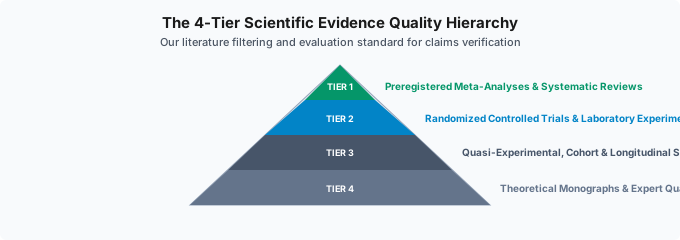
To ensure scientific integrity, we restrict our evidentiary analysis to a transparent, four-tier source hierarchy:
Tier 1: Preregistered Meta-Analyses and Systematic Reviews (Highest Weight)
Quantitative syntheses pooling effect sizes across multiple independent laboratories (e.g., Dunlosky et al., 2013; Donoghue & Hattie, 2021; Cepeda et al., 2006). We prioritize reviews that adhere to PRISMA reporting guidelines and assess publication bias through funnel plots and p-curve analyses.
Tier 2: Randomized Controlled Trials and Laboratory Experiments
Primary empirical investigations comparing an active instructional intervention against an active control group under controlled conditions (e.g., Roediger & Karpicke, 2006; Deslauriers et al., 2019; Bastani et al., 2025). Studies must report exact sample sizes, methodology, and standard effect size metrics (Cohen’s $d$ or Hedges’ $g$).
Tier 3: Quasi-Experimental, Longitudinal, and Cohort Studies
Field evaluations, observational tracking, and expert performance analyses conducted in authentic workplace, clinical, or classroom settings where full experimental randomization was not feasible.
Tier 4: Foundational Theoretical Frameworks and Expert Treatises
Influential conceptual models authored by recognized domain pioneers (e.g., Sweller’s Cognitive Load Theory, Ericsson’s Deliberate Practice framework, Fitts & Posner’s motor acquisition phases). Tier 4 sources provide structural taxonomies but cannot alone validate causal efficacy claims.
Evidence Badges Defined
Every knowledge article and empirical claim on this site carries an explicit evidence badge, allowing readers and automated crawlers to immediately discern the scientific certainty behind any statement:
- Strong Evidence: The practice has been validated across multiple independent randomized controlled trials and replicated meta-analyses with consistent, practically meaningful effect sizes ($d \ge 0.40$). Boundary conditions are well understood.
- Moderate Evidence: Replicated empirical support exists across several controlled trials ($d \approx 0.20$ to $0.39$), but efficacy depends significantly on learner expertise, task complexity, or specific domain constraints.
- Mixed / Contested Evidence: Substantial empirical conflict exists in the published literature. Large-scale replication attempts fail to corroborate initial effect sizes, or findings are highly moderator-dependent (e.g., growth mindset interventions, brain training games).
- Emerging Evidence: Recent experimental trials or field deployments indicate promising mechanisms—particularly at the intersection of generative AI and tutoring—but longitudinal data and extensive cross-domain replications are still pending.
- Myth / Refuted: The claim has been directly tested under controlled experimental conditions and failed to demonstrate measurable benefits (e.g., matching instruction to sensory learning styles, subliminal audio learning).
- Descriptive / Taxonomic: Definitional, historical, or structural models that describe cognitive processes without asserting a comparative intervention effect.
Structured Claims Ledger and Verification
We maintain an authoritative programmatic claims register tracking every factual proposition presented across our content network. Each claim entry records:
- The exact declarative proposition and underlying causal assertion.
- Assigned primary sources, including DOI links, publication years, and lead authors.
- Explicit boundary conditions, sample limitations, and documented failure modes.
- Independent verification status confirmed against primary texts.
By grounding each article in this structured database, we ensure consistent factual representation across all pages covering human learning and skill development.
180-Day Review Cycles and Corrections Policy
Scientific understanding is never static. We enforce a mandatory 180-day audit cycle for all pages carrying an Emerging or Mixed status, ensuring our analyses incorporate the latest peer-reviewed publications.
If new empirical research refutes, refines, or qualifies any recommendation published on this site, we update the claims ledger, recalibrate the assigned evidence badge, and document the substantive revision in our public changelog. Readers and researchers can inspect our editorial governance and author background via our author profile.