Expertise: What It Is and How Experts Develop (Stages, Practice and Knowledge)
What is expertise?
In cognitive science and performance psychology, expertise is defined as consistently superior, replicable performance on representative tasks within a specific professional, intellectual, or athletic domain. Popular intuition frequently conflates expertise with academic credentials, social prestige, job titles, or decades of seniority. Empirical researchers, by contrast, define expertise strictly through demonstrated behavioral outcomes.
First operationalized by K. Anders Ericsson and Jacqui Smith (1991), genuine expertise must satisfy three rigorous empirical criteria:
- Superiority: Performance must reliably exceed that of peers by a statistically significant margin, typically falling at least two standard deviations above the population mean.
- Replicability: The superior capability must be demonstrated consistently across standardized, representative tasks, ruling out lucky streaks, environmental anomalies, or one-off successes.
- Traceability: The psychological, cognitive, and physiological mechanisms mediating superior execution must be measurable, dissectible, and explainable through controlled scientific analysis.
To isolate these mechanisms under rigorous laboratory and field conditions, cognitive psychologists employ the expert performance approach, capturing representative tasks, identifying the underlying mediating mechanisms, and tracing how those mechanisms were acquired through deliberate intervention.
How do experts differ from other people?

For over a century, popular culture assumed that world-class performers—such as chess grandmasters, concert soloists, diagnostic radiologists, and master surgeons—possessed extraordinary, innate general faculties: photographic visual memory, vast working memory capacity, or towering general intelligence ($g$).
Empirical research has thoroughly dismantled this general-superiority myth. When tested outside their specific domain of mastery, experts display completely ordinary cognitive limits:
- Chess grandmasters exhibit ordinary short-term digit spans and struggle to recall random sequences of numbers or letters just like novices.
- Elite diagnostic radiologists perform no better than lay college students on standard embedded-figure or hidden-object visual puzzles.
- Master software engineers demonstrate average memory when recalling arbitrary pseudocode or scrambled programming syntax.
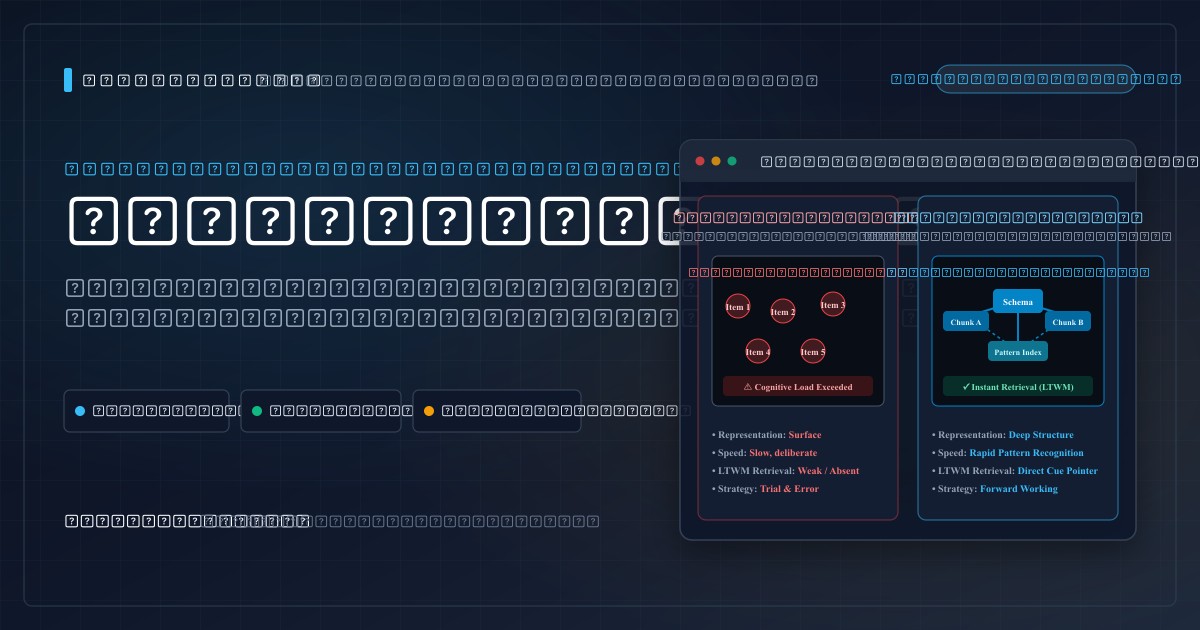
The expert advantage is strictly domain-specific. It does not reflect a superior biological central processing unit, but rather how knowledge is organized and accessed in long-term memory. As documented in cognitive comparisons of novice vs expert problem solving, top performers differ from novices in four fundamental cognitive ways:
- Perceptual Chunking: Experts perceive situations in terms of large, meaningful patterns rather than isolated data points.
- Deep Structural Representation: Experts categorize problems according to fundamental governing principles rather than superficial surface props.
- Forward Reasoning: Experts reason forward from known facts toward a solution, whereas novices reason backward from an unknown target using high-effort means-ends analysis.
- Metacognitive Error Calibration: Experts continuously monitor their own execution, rapidly detecting subtle discrepancies between expected and actual outcomes.
What are the cognitive mechanisms of expert performance?
To understand how experts execute complex decisions with speed and precision, cognitive scientists examine the specific mental architecture that bypasses standard human cognitive bottlenecks.
1. Rapid Perceptual Chunking
The human working memory system is severely bottlenecked, reliably processing only three to four discrete items simultaneously. Experts overcome this severe limit through perceptual chunking: binding multiple individual elements into a single coherent, meaningful unit stored in long-term memory. A novice chess player looking at an opening position sees 32 individual pieces on 64 squares. A grandmaster sees two interrelated pawn structures and an open diagonal—a single compound chunk. By recognizing familiar constellations, experts compress massive amounts of environmental data into high-density informational units, driving rapid pattern recognition under extreme time pressure.
2. Long-Term Working Memory (LTWM)
In their seminal theoretical synthesis, Ericsson and Kintsch (1995) resolved a longstanding paradox: if working memory is strictly limited to four items, how can a master chess player play 25 simultaneous blindfold games, or an emergency physician manage multiple crashing trauma patients without cognitive collapse?
They identified Long-Term Working Memory (LTWM): a specialized cognitive mechanism wherein experts construct durable, hierarchical retrieval structures in long-term memory. Working memory does not hold the actual raw data; instead, it holds active retrieval cues that link directly to organized knowledge nodes in long-term storage. By manipulating these cues, experts access, update, and modify vast constellations of long-term information in milliseconds without saturating working memory capacity.
3. Principled Planning and Forward Reasoning
Novices solve domain problems through backward means-ends analysis: looking at the goal, calculating the gap between the goal and current state, and searching for an operator to close that gap. This backward search consumes massive working memory capacity.
Experts, having identified the deep structure of the problem, execute forward reasoning. They retrieve an automated solution schema from long-term memory, evaluate the initial conditions, and proceed forward sequentially along a validated trajectory. In mathematical physics, expert physicists write out the foundational governing equation within seconds, whereas novices wander through algebraic substitutions trying to isolate the unknown variable.
4. Metacognitive Error Detection
Elite performers possess highly refined internal reference standards. When executing a motor, musical, or analytical task, they run an internal simulation of the intended outcome concurrently with execution. In a classic longitudinal investigation of children learning musical instruments, McPherson and Renwick (2001) demonstrated that the single strongest predictor of rapid skill acquisition was not the number of minutes spent playing, but the immediate detection and correction of errors. Novices play through mistakes without noticing or simply repeat the entire piece from the beginning; experts stop instantly at the millisecond of error, isolate the mechanical flaw, and adjust their representation before proceeding.
How do mental representations organize expert knowledge?
At the foundation of all expert performance lies the concept of mental representations: domain-specific cognitive structures stored in long-term memory that correspond to objects, situations, relationships, and processes. As formulated by Ericsson and Pool in Peak: Secrets from the New Science of Expertise, mental representations are preexisting patterns of information that allow the mind to visualize complex scenarios, plan actions, evaluate alternatives, and react rapidly without cognitive exhaustion.
To model how knowledge is structured in the expert mind, cognitive scientists identify a three-tier hierarchy spanning perceptual chunks to abstract principles:

- Chunks (Perceptual Foundation): Modular clusters of elementary features (such as 3–5 chess pieces in a castled pawn formation or a standard medical symptom cluster) recognized as a single unit. In their pioneering work, Simon and Gilmartin (1973) calculated that international chess masters store approximately 50,000 distinct perceptual chunks in long-term memory.
- Templates (Configurable Core Structures): Extended by Fernand Gobet and Herbert Simon (1996) in Template Theory, templates are larger perceptual structures consisting of a fixed, invariant core coupled with several variable “slots.” While a simple chunk is static, a template can hold variable situational parameters—allowing an expert to instantly assimilate changing conditions without rebuilding their cognitive model from scratch.
- Schemas (Conceptual Principles): The highest organizational tier, schemas are abstract cognitive frameworks that categorize situations according to causal mechanics, theoretical laws, and invariant relational structures (Chi et al., 1981).
Developing elite competence is fundamentally the process of building, expanding, and refining these mental representations so they mirror the deep causal architecture of your domain.
What does empirical research prove about expertise?
Six decades of cognitive psychology and neuroscience experiments provide concrete proof of how expert performance operates:
- Perception in Chess (Chase & Simon, 1973): When shown a chess position from an actual master game for five seconds, grandmasters accurately reconstructed the positions of 25 pieces with over 90% fidelity, while novices placed only four or five. Crucially, when the identical pieces were placed randomly on the board—destroying tactical meaning—the grandmasters’ recall crashed to the exact level of novices. Their advantage was not superior photographic memory, but domain-specific chunking.
- Digit Span and LTWM Expansion (Ericsson, Chase & Faloon, 1980): Normal working memory holds roughly 7 digits. Over two years of deliberate practice, an undergraduate track runner, Steve Faloon, expanded his digit span from 7 to 82 random digits. Faloon achieved this by encoding sequences of three and four digits as competitive running times (e.g., 3492 became “3 minutes 49.2 seconds, a near-world-record mile”), organized within a hierarchical retrieval tree in long-term memory. Later, Dario Donatelli used a similar method to exceed 100 digits.
- Structural Neuroplasticity in London Taxi Drivers (Maguire et al., 2000, 2006): Licensed London taxi drivers spend three to four years memorizing “The Knowledge”—navigating 25,000 streets and thousands of landmarks within a six-mile radius of Charing Cross. Structural MRI scans revealed that taxi drivers possess significantly larger posterior hippocampi (the brain region responsible for spatial representation) compared to matched control subjects. Longitudinal follow-up proved this was not self-selection: hippocampal volume increased systematically over the training period and regressed slightly upon retirement, providing direct anatomical proof that intensive deliberate practice physically reshapes the brain.
- Physics Problem Categorization (Chi, Feltovich & Glaser, 1981): Novices and doctoral physicists were asked to categorize 20 physics problems. Novices grouped problems by superficial surface features: problems with inclined planes, problems with springs, or problems with rotating pulleys. Experts ignored surface props entirely and grouped problems by deep physical invariants: problems governed by Newton’s Second Law ($F = ma$), Conservation of Momentum, or the Work-Energy Theorem.
- Acquisition of Absolute Pitch (Sakakibara, 2014): For centuries, absolute (perfect) pitch was considered the ultimate archetype of an immutable genetic gift, found in only 1 in 10,000 individuals. Ayako Sakakibara trained 24 children aged 2 to 6 using a systematic chord-identification method. Every single child in the study acquired absolute pitch, proving that what appeared to be an innate biological talent was actually a mental representation that can be reliably built during specific developmental windows.
These empirical breakthroughs fuel the ongoing scientific inquiry into talent vs practice, demonstrating that deliberate cognitive engineering accounts for capabilities once thought to be purely hereditary.
How does expertise develop through practice?
The development of expertise is an arduous, multi-year developmental trajectory. In 1973, Simon and Chase formulated the “ten-year rule,” observing that no chess player had ever achieved international grandmaster status without dedicating at least a decade of intensive immersion. Subsequent investigations confirmed that achieving elite mastery universally demands years—typically between 8,000 and 20,000 hours—of structured immersion.
However, the passage of calendar time alone is powerless. Driving a car to work for twenty years does not turn a daily commuter into a Formula 1 driver. Real developmental progress requires understanding the three distinct categories of practice:
- Naive Practice: Simply executing a task repeatedly while assuming repetition automatically generates improvement (“I played tennis for an hour,” “I coded another webpage”). Once performance reaches an acceptable, automatic level, naive practice produces an arrested plateau.
- Purposeful Practice: Focused training with clear, measurable goals, sustained concentration, immediate self-evaluation, and deliberate pushes just beyond the comfort zone.
- Deliberate Practice: Purposeful practice conducted under the guidance of an expert teacher or coach within an established domain with codified training methodologies, explicitly designed to refine mental representations and isolate specific weaknesses.
Engaging in structured deliberate practice is the primary behavioral engine that separates elite performers from experienced amateurs.
┌─────────────────────────────────────────────────────────────────────────┐
│                      THE PRACTICE SPECTRUM                              │
├───────────────────┬──────────────────────────┬──────────────────────────┤
│ NAIVE PRACTICE    │ PURPOSEFUL PRACTICE      │ DELIBERATE PRACTICE      │
├───────────────────┼──────────────────────────┼──────────────────────────┤
│ • Repetition      │ • Specific target goals  │ • Tailored by coach      │
│ • Autopilot mode  │ • High concentration     │ • Well-codified field    │
│ • Within comfort  │ • Pushes past comfort    │ • Targets representation │
│ • No feedback     │ • Immediate feedback     │ • Replaces faulty models │
│ = Early Plateau   │ = Meaningful Improvement │ = Elite Mastery          │
└───────────────────┴──────────────────────────┴──────────────────────────┘
What developmental stages mark the journey to expertise?
To track how an individual progresses from following rigid rules to exercising fluid, context-sensitive judgment, researchers and professional training programs examine the five discrete stages of the dreyfus model:
| Stage of Development | Primary Performance Driver | Cognitive Architecture & Working Memory | Feedback Source |
|---|---|---|---|
| Novice | Context-free explicit rules | Working memory saturated; slow serial processing | External instructor / textbook |
| Advanced Beginner | Situational recognition begins | Chunking starts; recognizes recurring scenarios | Self-monitoring begins |
| Competent | Conscious hierarchical planning | Overload eliminated for standard routines | Standardized benchmark metrics |
| Proficient | Holistic intuitive pattern matching | Rich schemas; sees what is important effortlessly | Peer critique & performance telemetry |
| Expert / Master | Rapid fluid recognition & simulation | Long-Term Working Memory cues; effortless adaptation | Self-generated diagnostic simulation |
How much variance does deliberate practice explain?
While deliberate practice is necessary for world-class performance, the degree to which accumulated practice hours explain ultimate performance differences is actively debated. In 1993, Ericsson, Krampe, and Tesch-Römer published their study of elite violinists at the Berlin Music Academy, asserting that differences in practice hours accounted for virtually all performance variance among top performers.
However, a landmark meta-analysis by Macnamara, Hambrick, and Oswald (2014) examining 88 studies with 11,135 participants revealed that deliberate practice explains a substantial, yet domain-dependent, percentage of performance variance:
- Games (Chess, Go): Deliberate practice accounts for 26% of variance.
- Music: Deliberate practice accounts for 21% of variance.
- Sports: Deliberate practice accounts for 18% of variance.
- Education: Deliberate practice accounts for 4% of variance.
- Professions: Deliberate practice accounts for less than 1% of variance.
The remaining variance is mediated by starting age, working memory capacity, perceptual processing speed, personality traits, and physical anthropometry. Deliberate practice is universally necessary to attain expertise, but individual differences in cognitive architecture and biological constraints determine how rapidly and effectively an individual translates practice into performance.
How can you build expert mental representations?
Building high-fidelity mental representations requires moving beyond passive exposure. Cognitive psychology provides five concrete methodologies to actively construct and refine internal representations:
1. The Benjamin Franklin Reproduction Method
In his autobiography, Benjamin Franklin described how he transformed himself from a mediocre writer into an internationally celebrated essayist. He took essays from The Spectator, read them carefully, and wrote short summary hints for each sentence. Several days later, after forgetting the exact phrasing, he attempted to rewrite the complete essay from his brief hints. Finally, he compared his version against the original master text side by side, diagnosing his grammatical errors, vocabulary deficiencies, and structural lapses. By forcing his brain to regenerate expert prose and comparing the discrepancy against a master benchmark, Franklin rapidly built sophisticated mental representations of rhetorical structure.
2. The 3 Fs Framework
Ericsson highlighted that productive practice boils down to a tight, continuous feedback loop known as the 3 Fs:
- Focus: Full, undivided attention on a narrow technical component outside your comfort zone (e.g., executing a specific arpeggio transition or debugging a concurrency lock).
- Feedback: Immediate, unambiguous diagnostic data indicating whether the execution succeeded or failed.
- Fix It: Immediate adjustment and re-execution to replace the faulty representation before the error habituates.
3. The Top Gun Simulation Model
During the Vietnam War, the U.S. Navy suffered an alarming air combat kill ratio of barely 2:1. In response, they established the Naval Fighter Weapons School (Top Gun). Rather than relying on classroom lectures, Top Gun immersed pilots in intense, high-fidelity dogfight simulations against expert instructor pilots acting as adversaries. Crucially, after each simulated dogfight, instructors subjected pilots to grueling, unsparing debriefs: “Why did you turn there? What did you see? What did you fail to see? What should you have done differently?”
By forcing pilots to articulate their internal decision models and confronting them with objective radar telemetry, Top Gun systematically rebuilt their mental representations. When the pilots returned to combat, their kill ratio soared to over 12:1.
4. Systematic Variation (Variation Theory)
As formulated by Ference Marton, deep mental representations are not formed by repeating identical problems in a single context. True schemas require systematic variation: keeping critical structural invariants constant while varying surface variables. If a medical resident only practices diagnosing heart failure in elderly diabetic patients, their representation is contaminated by surface noise. By diagnosing heart failure across young athletes, pregnant women, and postoperative patients, the resident isolates the deep pathophysiological invariant.
5. Cognitive Apprenticeship
Originating with Allan Collins, John Seely Brown, and Susan Newman (1989), cognitive apprenticeship makes tacit expert thinking visible through six progressive steps:
- Modeling: The expert performs the task while verbalizing their internal reasoning process.
- Scaffolding: The expert provides structured support and templates to help the learner execute difficult subcomponents.
- Coaching: The expert observes the learner, offering real-time corrective prompts.
- Articulation: The learner explains their reasoning and strategy out loud.
- Reflection: The learner compares their performance with that of the expert or an objective benchmark.
- Exploration: The learner is pushed to solve novel, unprompted problems independently.
Applying proven principles of learning from experts accelerates the formation of high-level cognitive models.
What pitfalls stall the transition from competence to mastery?
Many professionals accumulate thousands of hours of work experience yet remain trapped in intermediate competence. Three critical cognitive pitfalls explain why:
How do routine and adaptive expertise diverge?
In 1986, cognitive theorists Giyoo Hatano and Kayoko Inagaki formulated a vital distinction between two fundamentally different types of top performers:
- Routine Expertise: The performer becomes exceptionally fast, efficient, and accurate at executing standard procedures in stable, predictable environments. However, because they never learned the deep conceptual principles underlying their procedures, their performance collapses when operating conditions change.
- Adaptive Expertise: The performer understands the theoretical mechanisms, historical assumptions, and causal variables behind the procedures. When unexpected disruptions occur, they invent new procedures and successfully navigate ambiguous challenges.
Cultivating adaptive expertise requires learners to question standard operating procedures, experiment with edge cases, and understand why a methodology works rather than merely how to execute it.
┌─────────────────────────────────────────────────────────────────────────┐
│                    ROUTINE VS ADAPTIVE EXPERTISE                        │
├───────────────────────────────────┬─────────────────────────────────────┤
│ ROUTINE EXPERTISE                 │ ADAPTIVE EXPERTISE                  │
├───────────────────────────────────┼─────────────────────────────────────┤
│ • Speed and efficiency            │ • Deep conceptual understanding     │
│ • Optimizes standard routines     │ • Flexible problem solving          │
│ • Brittle under novel conditions  │ • Thrives in ambiguous environments │
│ • Solves familiar problems fast   │ • Invents novel solutions           │
│ = High Efficiency, Zero Innovation│ = Masterful Innovation & Resilience │
└───────────────────────────────────┴─────────────────────────────────────┘
Why do experts struggle to teach beginners?
As cognitive representations become highly compiled and automated, experts lose conscious access to the foundational steps they routinely execute. This phenomenon—the curse of knowledge—creates a severe expert blind spot. A master programmer or senior surgeon perceives an entire diagnostic chain as an indivisible “obvious” step, forgetting the explicit rules, vocabulary, and cognitive scaffolding novices desperately need.
Why does over-scaffolding harm advanced learners?
In educational cognitive psychology, Slava Kalyuga and colleagues identified the Expertise Reversal Effect. Instructional techniques that provide essential scaffolding for novices—such as fully worked examples, explicit step-by-step guidance, and annotated diagrams—actually impair performance when presented to experts. For an expert, redundant instructional scaffolding conflicts with their established internal schemas, creating unnecessary cognitive load and reducing learning efficiency. As expertise develops, instructional materials must shift from structured guidance to autonomous problem solving.
How does expertise relate to skill acquisition?
Skill acquisition and expertise development occupy the same developmental continuum, but they operate at distinct scales of cognitive complexity.
A skill is a discrete, modular capability: executing a tennis backhand, writing an SQL query, or inserting an intravenous cannula. Foundational models of skill acquisition such as expertise (such as Fitts and Posner’s three-stage model) describe how an individual proceduralizes and automates a modular physical or cognitive task.
Expertise, by contrast, represents the macroscopic integration of thousands of coordinated skills, contextual heuristics, and predictive mental models into a unified cognitive system. A skilled tennis player can hit a clean volley when the ball is hit directly to their racket; an expert tennis player reads their opponent’s shoulder tilt and hip angle before the racket strikes the ball, anticipates the spin, glides into position, and hits the volley while simultaneously orchestrating their next three tactical shots.
To implement an end-to-end framework that bridges basic modular competence and advanced performance, explore our structured skill acquisition course.
Can anyone build expert-level mental representations?
The discovery that expertise is mediated by domain-specific mental representations rather than immutable general intelligence raises a fundamental question: can anyone, through sufficient deliberate practice, attain expert performance?
Empirical science provides a nuanced answer:
- The Biological Baseline: Neuroimaging studies confirm that human brains exhibit profound structural neuroplasticity throughout adulthood. Any individual with normal cognitive faculties can build extensive chunks, templates, and retrieval structures in virtually any codified domain.
- Critical Periods: Certain specialized representations exhibit sensitive developmental windows. Absolute pitch acquisition appears restricted to early childhood (before age 7). Native-like phonetic perception in secondary languages becomes significantly more difficult after puberty.
- The Power Law of Practice: In all domains, the rate of improvement is governed by a power-law function: early gains are rapid, but subsequent improvements demand exponentially greater investments of focused effort.
- Individual Differences: While deliberate practice is universally required, individuals differ substantially in the number of practice hours needed to attain a given benchmark. Starting age, working memory capacity, and physical attributes create distinct efficiency trajectories.
Achieving true mastery does not require superhuman genetic anomalies, but it does require thousands of hours of rigorously designed practice sustained over years.
Why does years of experience fail to produce expertise?

In business, government, and professional services, seniority is routinely treated as a direct proxy for expertise. An engineer or physician with twenty years on the job is assumed to be far superior to one with four.
Cognitive science proves that experience does not equal expertise. Longitudinal evaluations across medicine, clinical psychology, financial forecasting, and school teaching demonstrate that after an initial 3–5 year steep learning curve, professional performance typically reaches an arrested plateau—and in many fields, diagnostic accuracy actually declines slightly with advancing years of tenure.
Why does tenure fail to improve performance?
- Premature Automaticity: Once an individual achieves functional competence, daily work shifts into autopilot. The professional executes familiar routines comfortably with minimal conscious effort, preventing the formation of new mental representations.
- Absence of Calibrated Feedback: In professional environments, true outcome feedback is rare, noisy, delayed, or distorted. A clinical psychologist rarely receives objective long-term diagnostic tracking on former clients; a financial forecaster forgets bad predictions and remembers lucky calls.
- The “Good Enough” Trap: Routine professional practice optimizes for immediate task completion rather than technical refinement. Deliberate practice, by contrast, requires operating outside comfort, hunting for mechanical flaws, and risking mistakes in order to expand capability.
Maintaining genuine professional competence over a career demands transforming daily work from passive repetition into an active laboratory for deliberate performance feedback.
References & Scientific Evidence
- (1993).The role of deliberate practice in the acquisition of expert performance.
- (2014).Deliberate practice and performance in music, games, sports, education, and professions: A meta-analysis.
- (1994).Expert performance: Its structure and acquisition.
- (1973).Perception in chess.
- (1981).Categorization and representation of physics problems by experts and novices.
- (1996).Recall of rapidly presented random chess positions is a function of skill.
- (2014).Deliberate practice: Is that all it takes to become an expert?.
- (1995).Long-term working memory.
- (2000).Navigation-related structural change in the hippocampi of licensed London taxi drivers.
- (2001).A longitudinal study of self-regulation in children's musical practice.
- (2014).A longitudinal study of the process of acquiring absolute pitch: A practical report of training with the chord identification method.