Our Method: Cognitive Engineering for Learning and Expertise

What is Cognitive Engineering for Learning?
Cognitive engineering is the systematic discipline of designing instructional sequences, study environments, and deliberate practice routines to optimize the performance of human cognitive architecture. Rather than treating learning as an unpredictable art or relying on subjective intuition, our methodology models human learning as a biological information-processing system governed by verifiable physical constraints.
Understanding how people learn requires acknowledging two inescapable biological realities: working memory is severely constrained in capacity and duration, while long-term memory possesses virtually unlimited capacity but requires effortful, structured consolidation to remain retrievable. Cognitive engineering bridges this physiological gap by converting empirical cognitive psychology into reproducible protocols.
The 4-Phase Cognitive Engineering Framework
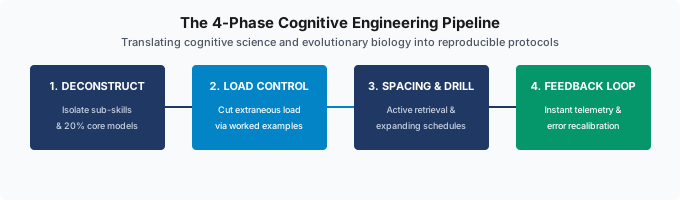
Our instructional design and curriculum architecture operate across four structured, sequential phases:
1. Structural Deconstruction and Domain Mapping
Every complex skill—whether mastering medical diagnostics, full-stack software development, or financial modeling—consists of an interconnected hierarchy of sub-skills, factual concepts, and mental models. In this opening phase, we deconstruct the target domain into:
- Core Declarative Schemas: The foundational 20% of theoretical concepts and causal mechanisms that govern 80% of domain performance.
- Procedural Sub-Skills: The discrete physical or cognitive operations that must be compiled into automated routines.
- Decision Heuristics: The conditional rules and diagnostic rubrics that determine when and how specific procedures should be deployed.
2. Cognitive Load Management
When novel material exceeds the processing capacity of working memory, cognitive overload occurs, halting schema acquisition. We engineer study materials to eliminate extraneous cognitive load while systematically calibrating intrinsic load:
- Worked Examples and Modeling: For novices, fully worked examples reduce extraneous search burdens, allowing working memory to focus entirely on schema induction.
- Goal-Free Problems: Removing narrow, high-stakes terminal goals reduces means-ends analysis, freeing cognitive bandwidth for recognizing structural relationships.
- Segmenting and Pacing: Complex multi-element systems are partitioned into sequentially masterable modules before being integrated into composite tasks.
3. Deliberate Retrieval and Interleaving
Passive consumption—such as highlighting text, re-reading notes, or watching video walkthroughs—creates a deceptive illusion of competence without stimulating lasting synaptic plasticity. We engineer active friction into every learning protocol:
- Effortful Reconstruction: Deploying low-stakes practice testing forces the brain to reconstruct memory traces, dramatically increasing durability and accessibility; our taxonomy of learning strategies provides the operational protocols for these retrieval interventions.
- Expanding Spaced Schedules: Reviews are distributed across expanding chronological intervals aligned with biological memory consolidation.
- Contrastive Interleaving: Rather than practicing one skill in isolated blocks, we alternate related problem types, forcing learners to identify structural distinctions and prevent superficial pattern-matching.
4. Calibrated Performance Feedback
Skill development stalls when practice becomes routine, automated, and devoid of critical feedback. We design closed-loop training environments where performance errors are surfaced instantaneously:
- Formative Task Feedback: Actionable critique focused directly on the execution process and underlying problem-solving logic rather than the learner’s ego or fixed ability.
- Metacognitive Audits: Explicit routines that prompt learners to predict their performance before testing and evaluate their errors afterward, calibrating their internal monitoring systems; applying these structured principles accelerates authentic skill acquisition across complex domains.
The Evidence Hierarchy and Verification Protocol
A cornerstone of our method is transparent empirical verification. We evaluate instructional claims against a strict 4-tier hierarchy:
- Tier 1 (Highest): Preregistered, large-scale systematic reviews and meta-analyses published in leading peer-reviewed journals.
- Tier 2: Randomized controlled laboratory experiments and authentic classroom trials.
- Tier 3: Quasi-experimental, cohort, and expert case analyses.
- Tier 4: Foundational theoretical monographs, qualitative frameworks, and observational analyses.
Every technique we recommend is accompanied by its empirical evidence badge, transparently distinguishing interventions with high meta-analytic effect sizes from emerging hypotheses or persistent educational myths.