Learning Plateaus: Why Progress Stalls and 7 Ways to Break Through

What is a learning plateau?
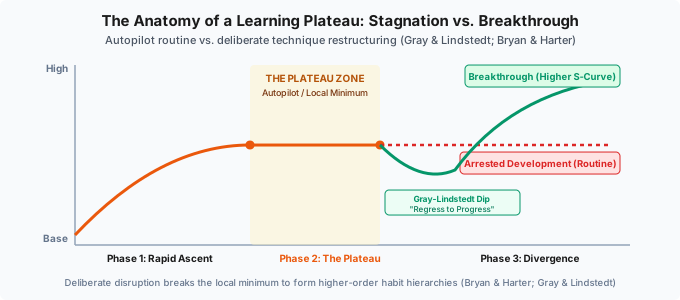
A learning plateau is an extended period during skill acquisition where observable performance metrics—such as speed, error rate, diagnostic accuracy, or output volume—flatten or stall completely despite sustained, regular practice. Whether a student is learning conversational Japanese, a programmer is learning systems architecture, or an athlete is refining a swing, progress initially feels rapid, only to grind to an exasperating halt.
Human learning is fundamentally non-linear. In his classic study of high achievement (Mastery), George Leonard established that skill acquisition is never a smooth, continuous upward ramp. Rather, it consists of brief spurts of progress followed by a slight decline to an extended plateau that is higher than the previous baseline.
The empirical investigation of plateaus began in the late nineteenth century with William Lowe Bryan and Noble Harter’s pioneering 1897 and 1899 investigations of telegraph operators. Bryan and Harter documented that student operators made steady weekly progress in sending and receiving individual letters, but then hit a stubborn performance plateau that lasted for months. As psychologist Susan David notes, approximately 75 percent of the telegraph operators settled on this plateau permanently once they reached a functional standard. Only 25 percent broke through—and they did so solely by restructuring their mental representations from processing isolated letters to perceiving integrated words and multi-word phrases, a transformation Bryan and Harter termed the “acquisition of a hierarchy of habits.”
Crucially, modern cognitive science proves that a learning plateau is not evidence of a genetic intellectual ceiling. It is an emergent, normal characteristic of complex skill acquisition, indicating that a learner’s existing operational strategy has reached its structural capacity.
Furthermore, as educational psychologist Susan Ambrose and colleagues (How Learning Works) emphasize, plateaus often suffer from an insensitivity problem in measurement: crude surface metrics (such as words typed per minute or gross score accuracy) become insensitive at performance extremes. In novices, early muscle adjustments sound harsh on a violin despite real coordination gains; in advanced performers, subtle refinements in timing and cognitive economy do not register on blunt assessments.
Why do plateaus happen?
When performance stalls, learners instinctively assume that they have run out of talent or that further effort is futile. In cognitive science and neuroscience, plateaus are driven by six distinct structural mechanisms:
1. Premature Automaticity (The Autopilot Trap)
In his foundational deliberate practice research, K. Anders Ericsson (2008) observed that when individuals practice a skill until it becomes comfortable and automated, improvement abruptly stops. In The Little Book of Talent, Daniel Coyle identifies the root cause: when an action enters the autonomous stage, execution is delegated to subcortical motor programs in the basal ganglia, shielding performance from conscious oversight. Neurophysiologist Karl Pribram modeled this as the withdrawal of prefrontal “effort and cognitive systems,” leaving the habitual system to run on autopilot. While automaticity is biologically adaptive for energy conservation, it arrests further skill development. Ericsson termed this state “arrested development.”
2. The “Local Minimum” Trap
Cognitive neuroscientist Stanislas Dehaene (How We Learn) draws an explicit parallel between human skill learning and computational gradient descent. In neural networks and human minds, learning navigates an error landscape to find optimal solutions. An algorithm frequently gets trapped in a “local minimum”—a depression in parameter space where all immediate, incremental changes increase errors and feel counterproductive. The cognitive system remains blind to a superior global optimum located just beyond the ridge, mistaking the local trap for an absolute ceiling.
3. Strategy Exhaustion and Heuristic Ceilings
Novices inevitably adopt heuristic strategies that are easy to acquire and yield immediate early dividends. However, every heuristic possesses an immutable physical limit:
- A touch typist looking down at the keyboard can reach 40 words per minute, but that visual-hunting heuristic physically cannot exceed 60 words per minute.
- A programmer who relies on brute-force procedural scripting can solve simple challenges, but that approach collapses under distributed enterprise architecture.
When a learner hits the structural boundary of their current strategy, repetitive practice within that exact same method yields zero forward progress. Breakthroughs demand dismantling the outgrown heuristic and compiling a higher-order abstraction.
4. The Gray-Lindstedt Regression Effect (“Regress to Progress”)
In a century-spanning analysis of cognitive and motor learning curves, researchers Wayne Gray and John Lindstedt demonstrated that when performance on complex tasks (ranging from Tetris to flight control) stalls, performance almost always declines before it improves again. As organizational psychologist Adam Grant (Hidden Potential) summarizes, when a learner discards an automated but limited technique to adopt a superior one, their initial clumsiness with the new mechanics temporarily inflates errors. To progress past an entrenched plateau, the cognitive system must regress in order to reorganize.
5. Hidden Consolidation and the “Improvement Factory”
What appears to be a flatline on a performance graph frequently conceals profound neurological adaptation. Performance psychologist Dr. Nate Zinsser (The Confident Mind) reframes plateaus as “improvement factories”: during periods of flat behavioral metrics, the nervous system is actively engaged in structural myelination, thickening the protective sheaths along activated neural pathways to insulate the circuit. In cognitive learning curve models, Ritter and Schooler (2001) demonstrated that linear coordinate graphs visually compress later progress; when plotted on log-log scales, many supposed plateaus reveal continuous, covert micro-consolidation.
6. Biological Adaptation and Stimulus Accommodation
In athletic and biomechanical skills, the physical body accommodates to repeated loads. Fitness experts Mark Verstegen and Steven Low (Overcoming Gravity) point out that the neuromuscular system is exceptionally efficient at adapting to familiar stress. When the same drills are executed with identical volume, tempo, and sequence, physiological adaptation ceases. Progress stalls until progressive overload or structured variation forces systemic adaptation.
How do you break through a plateau?
Breaking an entrenched plateau requires deliberately shattering comfortable habits and forcing the cognitive architecture to reorganize. Cognitive psychology validates seven research-aligned interventions:
- Disrupt Autopilot via “Desirable Difficulties”: Educational psychologist David Didau notes that introducing conditions that slow down apparent immediate performance dramatically enhances long-term mastery. Daniel Coyle suggests deliberately jostling the nervous system out of autopilot: execute the task at double speed, practice in extreme slow-motion to expose micro-flaws, or perform movement sequences in reverse order.
- Practice Failing (The 10–20% Speed-Up Protocol): In Practice Perfect, Doug Lemov cites Joshua Foer’s research on typists trapped on the “OK Plateau.” Typists only broke through when challenged to type 10 to 20 percent faster than their comfort zone while actively allowing errors to occur. By pushing past mechanical stability, they forced conscious error-correction systems to rebuild faster neural circuits.
- Strategic Method Restructuring (Embracing the Gray-Lindstedt Dip): Accept that adopting a new mental model or grip will cause a transient 15–30% drop in speed or accuracy. Treat this regression as an essential engineering phase rather than a failure of competence.
- Deploy the Deliberate Practice Protocol: Replace mindless repetition with the systematic deliberate practice method explained. Establish precise micro-goals, isolate component weaknesses, and analyze every mechanical error with clinical detachment rather than emotional frustration.
- Strategic Incubation, Sleep, and Spacing: Stepping away from an intractable impasse facilitates covert cognitive restructuring. A meta-analysis of incubation effects by Sio and Ormerod (2009) confirmed that taking a low-demand break away from a difficult problem produces significant insight gains ($d = 0.22$ to $0.29$). Paired with overnight slow-wave sleep and strategic spacing (allowing retrieval strength to dip so that re-engagement builds deep storage strength, as formulated by Manu Kapur and Robert Bjork), incubation allows fixation-inducing mental sets to decay.
- Micro-Milestones and Dopamine Calibration: As Douglas Brackmann (Driven) and educational researchers McTighe and Willis point out, long plateaus deplete dopamine reserves because crude benchmarks fail to register progress. Break the plateau down into micro-commitments and micro-adjustments, celebrating microscopic technical improvements to sustain attentional engagement.
- Formative Diagnostic Feedback: Seek out an expert mentor or objective telemetry tool to expose blind spots invisible to your own internal monitoring. Precise corrective feedback provides the error signals required to escape a local minimum.
To adopt an engineered, step-by-step training curriculum that guides you through breaking plateaus across technical and professional crafts, explore our complete expertise course.
What does the research show about plateaus?
While the concept of a learning plateau is ubiquitous in popular culture and athletic coaching, consumers of science must understand the nuances of the academic literature:
- The S-Curve vs. Power Law Debate: In classic cognitive psychology, Newell and Rosenbloom (1981) formulated the Power Law of Practice, which models skill improvement as a smooth, continuous power function with diminishing returns rather than distinct plateaus. Mathematical psychologists (Heathcote, Brown, & Mewhort, 2000) argue that learning curves are better described by exponential functions. However, both mathematical models aggregate group data across thousands of trials, which tends to average out individual step-like plateaus. In real individual learners, progress follows a series of interconnected S-curves.
- Limited Direct Plateau Trials: Most empirical literature in cognitive psychology examines continuous laboratory learning curves rather than long-term, multi-month plateaus. Dedicated laboratory experiments explicitly inducing and tracking plateaus remain relatively rare due to the logistical difficulty of tracking participants across hundreds of hours.
- Repetition Does Not Equal Improvement: K. Anders Ericsson and Alan Baddeley emphasize that Malcolm Gladwell’s popularized “10,000-hour rule” fundamentally distorts the science. Accumulating 10,000 hours of routine, comfortable execution cements an arrested development plateau; only effortful practice at the frontier of current capability drives breakthrough.
- Variability Must Be Targeted: Indiscriminately increasing practice variability does not guarantee progress. Random or chaotic variations that disconnect from authentic performance introduce confusion without enhancing transfer. Practice modifications must specifically target diagnosed mechanical bottlenecks.
How do you tell a plateau from burnout or low motivation?
When progress stalls, learners frequently misdiagnose their condition, mistaking a cognitive learning plateau for clinical burnout, or vice versa:
| Dimension | Learning Plateau | Burnout & Exhaustion | Boredom / Habituation |
|---|---|---|---|
| Cognitive Engagement | High: the learner remains curious, engaged, and eager to solve the impasse | Depleted: the learner feels cynical, detached, and emotionally numb | Under-stimulated: the task no longer offers sufficient novelty or challenge |
| Effort Quality | Focused practice continues, but performance metrics flatline | Mental concentration collapses; practice becomes impossible to sustain | Execution shifts to mindless autopilot; attention wanders |
| Response to Rest | Returning after a 48-hour break produces renewed problem-solving vigor | Returning after a short break still feels exhausting and overwhelming | Returning to the identical routine immediately triggers boredom |
| Neurobiology | Active myelination and covert synaptic restructuring (Improvement Factory) | Chronic hypothalamic-pituitary-adrenal (HPA) axis stress exhaustion | Dopaminergic deficit due to lack of novel stimuli or perceived progress |
| Corrective Action | Strategy restructuring, sub-skill isolation, and deliberate disruption | Complete psychological detachment, workload reduction, and deep recovery | Introduce task variety, periodization, and intermediate challenge |
As Olympic gymnastics medalist Shawn Johnson and Andrew East (The Courage to Commit) note, boredom is an evolved cognitive signal: our brains seek novelty when tasks lack sufficient challenge or perceived control. If you are experiencing true motivational depletion rather than a strategic plateau, review our evidence-based guide on how to persist when learning is hard to rebuild sustainable emotional and attentional reserves.
How does a plateau relate to the learning curve?
To understand why plateaus occur, one must examine the mathematical geometry of the learning curve. When asking how long does it take to learn a skill, research confirms that human performance curves are non-linear: early practice trials produce rapid, dramatic leaps as the beginner eliminates obvious errors and grasps basic rules.
As writer Ben Meer points out, mastering a craft involves ascending through a sequence of interconnected S-curves:
- The Slog: Early slow progress while building foundational representations.
- The Sweet Spot: Rapid compounding gains as basic skills automate.
- The Plateau: Stalling as the current operational system reaches its maximum mechanical efficiency.
Because early gains arrive so effortlessly, learners mistakenly expect progress to maintain a steep, linear slope indefinitely. When natural deceleration sets in, they panic, misinterpreting the diminishing returns of the power law of practice as a catastrophic personal failure. A plateau is not the death of learning; it is the natural mathematical terrain of advanced skill acquisition.
Is every plateau a sign you should quit?
Encountering a performance plateau is never an intrinsic signal of incompetence or a sign that you have reached the limits of your biological potential.
In developmental cognitive psychology, Robert Siegler formulated the Overlapping Waves Theory: learning is not a rigid staircase where one step neatly succeeds another, but an ebbing and flowing wave of competing cognitive strategies. Old, familiar methods recede slowly while new, superior approaches gain dominance.
A plateau indicates that an outgrown wave of strategy has reached its natural crest. As Ben Meer notes, “A plateau isn’t a problem; it’s a promotion. You’ve mastered the current level—your system has done exactly what it was capable of doing. You’ve earned the right to build something better.”
When you reach a flatline while learning a new skill, celebrate it as a milestone: you have exhausted the easy gains, and your real journey toward expert mastery has just begun. Embrace the plateau, practice for the intrinsic craft itself, and allow the hidden neurological machinery of learning to do its work.
References & Scientific Evidence
- (1899).Studies on the telegraphic language: The acquisition of a hierarchy of habits.
- (2017).Plateaus, dips, and leaps: Where's the plateau in the learning curve?.
- (2008).Deliberate practice and acquisition of expert performance: A general overview.
- (2020).How We Learn: Why Brains Learn Better Than Any Machine... for Now.
- (2001).The learning curve.
- (1981).Mechanisms of skill acquisition and the law of practice.
- (2010).How Learning Works: Seven Research-Based Principles for Smart Teaching.
- (2009).Does incubation enhance problem solving? A meta-analytic review.
- (2021).When problem solving followed by instruction works: An explicit analysis of productive failure meta-analyses.
- (2000).The power law repealed: The case for an exponential law of practice.