Naive vs Deliberate Practice: Why Experience Alone Doesn't Make Experts

What is the difference between naive, purposeful, and deliberate practice?
One of the most pervasive misconceptions in education and professional development is the belief that repetition alone produces improvement. In Peak: Secrets from the New Science of Expertise, cognitive psychologist K. Anders Ericsson and Robert Pool established that the human cognitive and neuromuscular architecture does not adapt simply because an activity is performed repeatedly. Instead, the trajectory of skill development depends entirely on the intent, structure, and cognitive feedback embedded within the practice.
To understand how expertise is built, cognitive scientists categorize training into three distinct tiers:
- Naive Practice (Mindless Repetition): Naive practice is executing an activity repeatedly under the assumption that mere exposure will automatically yield mastery (“I just played the piece five times,” “I hit a bucket of golf balls,” “I did my job again today”). Naive practice operates without specific goals, without targeted error detection, and without real-time feedback. Once the performer reaches an “acceptable” level of proficiency, execution shifts to automaticity, and improvement permanently ceases.
- Purposeful Practice (Focused Effort): Purposeful practice introduces conscious structure. The practitioner establishes concrete goals, maintains undivided concentration, seeks immediate feedback, and pushes slightly beyond their comfort zone. While purposeful practice is vastly superior to naive repetition, it remains limited if the learner lacks proven pedagogical methods or does not understand how elite performers in the field structure their internal models.
- Deliberate Practice (The Gold Standard): Deliberate practice is purposeful practice informed by established training methods and guided by expert performers or coaches. It occurs within mature, codified disciplines (such as classical music, chess, gymnastics, or surgery) where standards of excellence are objective and reproducible. Deliberate practice targets isolated sub-skill weaknesses, provides immediate diagnostic feedback, and systematically builds increasingly sophisticated mental representations.
| Dimension | Naive Practice | Purposeful Practice | Deliberate Practice |
|---|---|---|---|
| Primary Approach | Mindless repetition on autopilot | Focused effort with specific goals | Expert-designed training targeting micro-weaknesses |
| Attentional Focus | Divided or low concentration | Full, undivided attention | Near-maximal cognitive focus |
| Comfort Zone | Comfortable and habitual | Pushing at the boundary of ability | Constantly operating at the edge of failure |
| Feedback Mechanism | Absent or ignored | Immediate self-monitored feedback | Immediate expert coach diagnostic evaluation |
| Field Maturity | Any casual activity | Any self-directed domain | Mature fields with proven training methodologies |
| Mental Representations | Static procedural habits | Developing basic patterns | Complex, highly organized hierarchical schemas |
| Long-Term Trajectory | Rapid plateau at “good enough” | Slower plateau without guidance | Continuous upward trajectory toward elite mastery |
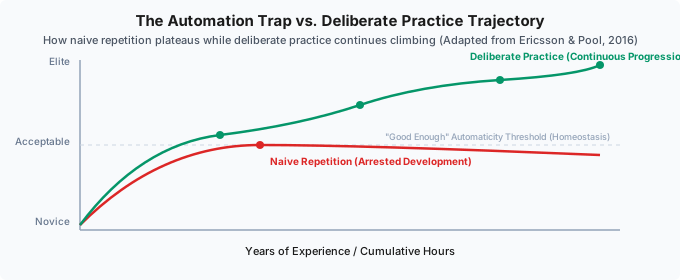
Why does “experience alone does not build expertise” matter?

The discovery that experience does not equal expertise strikes at the heart of how society evaluates competence. Across corporations, healthcare systems, and educational institutions, seniority is almost universally treated as an objective proxy for skill. We assume that a surgeon with twenty years in the operating theater is superior to one with five, or that a veteran corporate executive inevitably possesses sharper strategic judgment than a junior manager.
Cognitive science proves that this assumption is fundamentally flawed. In the absence of deliberate practice, performance does not steadily improve with time served; instead, it rapidly plateaus and frequently declines. Researchers trace this stagnation to several critical biological and behavioral mechanisms:
- The Homeostasis and Automation Trap: The human brain and neuromuscular system evolved to conserve metabolic energy by automating recurring behaviors (Fitts & Posner, 1967). Once an individual learns to drive a car, type an email, or conduct a routine clinical intake to an “acceptable” standard, execution shifts to automaticity. In this automated state, physical and cognitive friction disappears. Because the system is in equilibrium (homeostasis), no biological trigger exists to stimulate neural plasticity. Automated skills gradually deteriorate over time unless deliberately challenged.
- The “20-Year Physician” Paradox: In a landmark systematic review of healthcare outcomes across 62 published studies, Choudhry, Fletcher, and Soumerai (2005) examined the relationship between clinical experience and quality of patient care. The researchers revealed that over 70% of studies found that physicians with more years in practice actually delivered lower-quality care, adhered less strictly to evidence-based standards, and demonstrated poorer diagnostic accuracy than recent medical graduates. Because daily clinical routines rarely push doctors outside their comfort zone or provide immediate feedback on diagnostic errors, decades of unguided experience breed calcified habits rather than superior competence.
- The Benjamin Franklin Chess Case: Benjamin Franklin played chess passionately for over fifty years, logging thousands of hours against the finest players of the 18th century. Yet, as Ericsson observed, Franklin never attained master strength. Why? Because Franklin played exclusively for recreational pleasure. He never analyzed recorded master games, never isolated tactical combinations, and never pushed into the uncomfortable failure zone required to build grandmaster mental representations. He engaged in fifty years of naive practice.
- The Radiologist Feedback Gap: In screening mammography, radiologists interpret thousands of scans annually but rarely discover whether their negative assessments were accurate twelve months later. Without immediate ground-truth feedback, their diagnostic mental representations remain uncalibrated despite decades of daily reading.
Recognizing that experience does not produce expertise matters because treating seniority as competence leads to catastrophic organizational misjudgments: promoting individuals based on tenure rather than verified performance, designing training programs that merely pile on more passive flight hours or desk time, and creating self-fulfilling talent labeling. Building genuine expertise such as naive vs deliberate practice requires understanding that competence is the product of how you practice, not how long you have occupied a seat.
How to apply deliberate practice to daily learning and work

Transitioning from passive repetition to deliberate performance requires re-engineering how you engage with your craft:
The “3 Fs” Framework for Individual Mastery
When working without a dedicated full-time coach, self-directed learners must deploy Ericsson’s “3 Fs” framework to self-monitor and drive deliberate adaptation:
- Focus: Break the overall skill into modular sub-components. Concentrate 100% of your cognitive bandwidth on one specific micro-weakness at the frontier of your capability, restricting high-intensity drills to 45–60 minute blocks to maintain pristine focus.
- Feedback: Create an objective diagnostic error-detection mechanism. Utilize video recordings, automated unit tests, telemetry data, or direct comparison against expert benchmark solutions.
- Fix It: Design targeted, small-scale drills specifically engineered to eliminate the identified flaw. Avoid mindlessly repeating the entire piece or routine; drill the exact mechanical or cognitive failure point until execution becomes reliable.
The Benjamin Franklin Method for Cognitive and Creative Crafts
To improve analytical writing, software architecture, or strategic communication without a tutor, deploy the method Franklin used to master prose: select an acknowledged masterpiece in your field; study it deeply and generate compact sentence or logic hints; set the work aside for several days until the original phrasing fades; attempt to recreate the work from your hints; and compare your version against the master original to expose exact deficiencies in vocabulary, logic, and structure.
Turning Routine Work into High-Stakes Practice
Professionals cannot halt daily operations to practice in isolation. Instead, convert routine execution into deliberate training: before entering a meeting, sales presentation, or programming sprint, isolate one specific micro-skill to refine; execute the task with acute conscious monitoring; conduct an immediate debrief to evaluate performance against metrics; and apply those corrections to tomorrow’s workflow.
The “Top Gun” Simulation Model
High-stakes environments where real-world failure is dangerous (such as aviation, medicine, and emergency response) require simulation architectures. As demonstrated by the U.S. Navy’s Top Gun program and simulation-based healthcare training (McGaghie et al., 2011), constructing libraries of realistic cases with verified ground truth allows learners to experience compressed failure loops, undergo unsparing after-action debriefs, and rewire their mental models safely.
Shattering Plateaus by Trying Differently
When progress inevitably stalls, pushing harder with the same technique simply reinforces the flawed habit. The scientific solution is to try differently: push execution speed or task difficulty slightly past your limit to observe where the system fractures, identify the rate-limiting sub-skill, and design a novel constraint drill to rebuild that specific component.
How does deliberate practice relate to skill acquisition?
Understanding the difference between naive and deliberate training is the core foundation of cognitive skill development. When evaluating what is deliberate practice, researchers emphasize that deliberate practice is the active operational engine that drives a learner through the developmental continuum:
| Stage | Naive Practice Trajectory | Deliberate Practice Trajectory |
|---|---|---|
| Cognitive Stage | Struggle through rules; memorize surface facts | Isolate core models; scaffold with expert worked examples |
| Associative Stage | Develop crude habits; eliminate gross errors | Target micro-weaknesses; calibrate feedback loops |
| Autonomous Stage | Permanent Arrested Development: skill goes on autopilot | Continuous Disruption: introduce constraints to rebuild schemas |
Without deliberate intervention, reaching the autonomous stage is the death knell of skill progression: execution feels effortless and comfortable, but improvement halts completely. Deliberate practice intentionally introduces cognitive friction to prevent premature automaticity, ensuring that foundational competence continuously matures into elite capability.
How does this connect to broader skill development?
At the macro level, every domain—whether mastering a musical instrument, writing algorithmic code, or conducting complex negotiations—requires navigating the holistic architecture of skill acquisition.
By replacing mindless repetition with structured task deconstruction, explanatory feedback, and deliberate mental representation modeling, learners protect themselves against the illusion of competence and ensure that every hour of practice produces enduring neural reorganization.
References & Scientific Evidence
- (2016).Peak: Secrets from the New Science of Expertise.
- (1993).The role of deliberate practice in the acquisition of expert performance.
- (1967).Human Performance.
- (2005).Systematic review: the relationship between clinical experience and quality of health care.
- (2014).Deliberate practice and performance in music, games, sports, education, and professions: A meta-analysis.
- (2000).Navigation-related structural change in the hippocampi of taxi drivers.
- (2011).Does simulation-based medical education with deliberate practice yield better results than traditional clinical education? A meta-analytic comparative review.