Deliberate Practice: What It Is, Principles and Examples

What is deliberate practice?
Deliberate practice is a highly structured, purposeful form of training engineered specifically to improve performance in a targeted domain. Formulated by cognitive psychologist K. Anders Ericsson and detailed in Peak (Ericsson & Pool, 2016), deliberate practice is recognized as the “gold standard” of skill acquisition—the most effective methodology known for developing elite competence.
Unlike mindless repetition, casual recreation, or routine work execution, deliberate practice requires operating at the outer boundary of current capability under conditions of rigorous monitoring, established pedagogical methods, and targeted correction. To understand its distinct nature, cognitive scientists categorize training into three distinct tiers:
- Naive Practice: Simply executing an activity repeatedly and assuming improvement will occur naturally (“I just played the piece five times”). Naive repetition rapidly plateaus once baseline automaticity is reached.
- Purposeful Practice: Focused training with clear stretch goals, undivided attention, and immediate feedback, but conducted without established domain training methodologies or expert coaching.
- Deliberate Practice: Purposeful practice conducted within a mature, codified field that draws on proven pedagogical techniques, guided by an expert coach who identifies micro-weaknesses and designs customized remediation drills.
As Ericsson observed: “Deliberate practice is purposeful practice that knows where it is going and how to get there.” For an operational breakdown of how to structure your daily drills, explore the structured deliberate practice steps.
The seven core principles of deliberate practice

Deliberate practice is governed by seven foundational principles that separate transformative training from ordinary experience:
- Develops Established Skills: It takes place in codified fields (such as classical music, chess, gymnastics, or surgery) where standards of expert execution are objectively established and effective pedagogical methods already exist.
- Takes Place Outside the Comfort Zone: It requires learners to constantly attempt tasks just beyond their current reliable ability. Operating in this zone of proximal challenge demands near-maximal mental effort and is biologically strenuous rather than inherently enjoyable.
- Involves Specific, Measurable Goals: It replaces vague aspirations like “getting better” with concrete, small-scale performance targets that isolate specific execution flaws.
- Requires Undivided Attentional Focus: Conscious, deliberate cognitive control is mandatory. Mindless drilling or distracted repetition fails to engage neural plasticity.
- Relies on Immediate Feedback and Modification: Early training depends on coach evaluation; over time, the performer acquires the diagnostic capability to self-monitor and adjust execution in real time.
- Produces and Depends on Mental Representations: Deliberate practice systematically builds sophisticated cognitive frameworks that allow performers to process vast amounts of domain data, anticipate patterns, and bypass short-term working-memory limits; understanding what are mental representations clarifies how experts encode domain structure.
- Builds on Prior Sub-Skills Step-by-Step: Complex competencies are constructed by refining foundational elements, ensuring flawless mechanics early to avoid costly unlearning later.
Real-world examples of deliberate practice in action
Empirical investigations across diverse disciplines illustrate how deliberate practice operates in authentic performance environments:
Music: The Berlin Violinists Study
Ericsson, Krampe, and Tesch-Römer (1993) conducted the foundational study of deliberate practice at the Berlin Academy of Music. Examining violin students categorized into elite international soloists (“best”), proficient orchestra musicians (“good”), and music-education trainees (“teachers”), researchers revealed that the best students had accumulated an average of 7,410 hours of solitary deliberate practice by age 18, reaching over 10,000 hours by age 20. Elite performers did not simply log more playing time; they dedicated concentrated hours to dissecting micro-passages, correcting intonation errors, and following teacher-prescribed technical drills.
Memory: Steve Faloon and Digit Span Retrieval
Under laboratory conditions, undergraduate Steve Faloon began with a standard working-memory span of seven digits. Over two hundred deliberate training sessions, Faloon expanded his recall capacity to 82 random spoken digits. Rather than relying on raw memory, Faloon constructed sophisticated mnemonic retrieval structures, encoding digit sequences as track-and-field running times and dates. By operating continually at the outer limit of his capability—attempting one digit more than his previous ceiling—he re-architected his long-term memory access pathways.
Military: The Top Gun Fighter Weapons School
Established in 1968 by the U.S. Navy to address abysmal air-combat kill ratios in Vietnam, the Top Gun program paired student pilots (Blue Force) against expert instructor pilots (Red Force) in simulated dogfights. The decisive training occurred during mandatory “after-action reports,” where instructors utilized radar logs and camera telemetry to ruthlessly interrogate every split-second tactical choice. By forcing pilots to confront their errors and apply immediate tactical adjustments in flight the following morning, the Navy increased its air-combat kill ratio from 1:1 to 12.5:1.
Writing and Intellect: Benjamin Franklin’s Method
Lacking a formal composition tutor, Benjamin Franklin engineered a deliberate practice system to master prose. He took essays from The Spectator, recorded brief keyword hints for each sentence, and waited several days until the original phrasing had faded from memory. He then attempted to recreate the essays from his hints, comparing his text against the original to identify stylistic flaws. To build vocabulary, he translated essays into rhyming verse and back into prose; to practice structural organization, he jumbled his notes and forced himself to logically reconstruct the author’s argument.
Medicine: Diagnostic Radiology Simulations
In standard medical practice, radiologists frequently experience delayed or absent feedback regarding diagnostic accuracy on patient mammograms, leading to performance stagnation over decades. Simulation-based medical trials (McGaghie et al., 2011) demonstrate that providing digital libraries of historical scans with verified pathology outcomes allows practitioners to read high volumes of cases with immediate diagnostic feedback, rapidly refining perceptual pattern recognition without clinical risk.
STEM Education: Carl Wieman’s Physics Class
Nobel laureate Carl Wieman transformed introductory university physics by replacing traditional lectures with deliberate-practice problem solving (Deslauriers, Schelew, & Wieman, 2011). Students prepared before class and spent lecture periods resolving diagnostic “clicker questions” in small groups, receiving real-time instructor feedback that immediately challenged conceptual misunderstandings. On standardized tests of physics comprehension, students in the deliberate-practice section scored an average of 74%, compared to 41% for students in traditional lecture sections.
Neuroscience: London Taxi Drivers
London cab drivers must master “The Knowledge”—the spatial layout of 25,000 streets and thousands of landmarks within a six-mile radius of Charing Cross. Eleanor Maguire and colleagues (2000) conducted structural MRI scans of licensed drivers, discovering that navigating this massive spatial representation physically enlarged their posterior hippocampi. The structural neural expansion correlated directly with the number of years spent actively navigating, proving that intensive deliberate practice physically reshapes human brain architecture.
What does the scientific research show across domains?
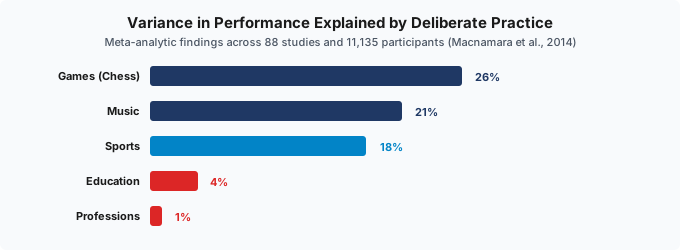
While Ericsson’s initial publications suggested that accumulated deliberate practice accounted for nearly all performance differences between experts and novices, subsequent quantitative meta-analyses revealed a more nuanced reality.
In a comprehensive meta-analysis synthesizing 88 studies across 11,135 participants, Macnamara, Hambrick, and Oswald (2014) quantitatively examined how much variance in performance deliberate practice actually explains:
- Games (e.g., chess, Go): Deliberate practice accounted for 26% of variance.
- Music: Deliberate practice accounted for 21% of variance.
- Sports: Deliberate practice accounted for 18% of variance overall, but only 1% of variance among elite athletes.
- Education: Deliberate practice accounted for 4% of variance.
- Professions: Deliberate practice accounted for less than 1% of variance.
These findings demonstrate that deliberate practice yields its highest return in highly codified, predictable domains with stable rules, objective performance metrics, and rapid feedback loops (such as formal games and classical music). In contrast, open-ended environments like professional management, entrepreneurship, and creative writing lack stationary rules and immediate unambiguous feedback, reducing the predictive power of isolated practice routines.
What do critics argue?
Critics of Ericsson’s framework (Macnamara et al., 2014, 2018; Campitelli & Gobet, 2011) raise three primary empirical objections:
- The Unexplained Variance: In every domain examined, the majority of performance variance remains unexplained by deliberate practice alone. In chess and music, between 66% and 79% of variance reflects factors other than practice hours.
- Massive Individual Practice Variability: Campitelli and Gobet (2011) showed that the number of deliberate practice hours required to attain the chess master title ranged from 3,016 hours to 23,608 hours—an eight-fold variation. Furthermore, some individuals accumulated over 25,000 hours without ever reaching master status.
- Cognitive and Biological Constraints: Individual differences in working-memory capacity, visual-spatial reasoning, starting age, and genetic predispositions influence the speed and ceiling of skill acquisition.
Under the Multifactorial Gene-Environment Interaction Model (MGEM), deliberate practice is understood as necessary but not sufficient. While no individual achieves world-class mastery without intensive practice, practice alone does not guarantee elite achievement without supporting cognitive and developmental conditions.
What do supporters say in response?
Ericsson and colleagues countered these critiques by arguing that broad meta-analyses compromised measurement validity by conflating unstructured activity with genuine deliberate practice:
- Conflation of Practice Types: Meta-analyses frequently aggregated group play, team scrimmages, and work experience alongside individualized solitary remediation. In sports, when practice was restricted strictly to individualized coach-assigned drills, the correlation rose to $r = 0.54$, explaining approximately 29% of variance (Ericsson, 2019).
- Subjective Retrospective Surveys: Retrospective self-reports across a decade or more suffer from severe recall error and social desirability bias.
- Focus on Sub-Elite Populations: Ericsson emphasized that the deliberate practice framework was designed to account for the acquisition of extraordinary, reproducible expert performance in mature domains, rather than baseline competence in introductory schoolwork.
How can self-directed learners apply deliberate practice?

For independent learners seeking skill mastery without a dedicated full-time coach, Ericsson and Pool (2016) outline the “3 Fs” framework to simulate deliberate practice:
- Focus: Break the overall skill into isolated sub-components. Concentrate 100% of your cognitive bandwidth on executing one specific element at the frontier of your ability, limiting practice sessions to 45–60 minutes to maintain high attentional fidelity.
- Feedback: Establish an objective diagnostic mechanism to detect errors immediately. This can include video self-recording, benchmarking against master models, automated unit tests, or peer review.
- Fix It: Design targeted, micro-scale drills specifically engineered to eliminate the identified flaw. Avoid mindless full repetitions; drill the isolated failure point until execution becomes reliable.
For self-directed professionals seeking a structured curriculum to operationalize these principles, our deliberate practice course provides end-to-end templates for designing feedback loops, tracking skill metrics, and preventing automated plateaus across diverse technical competencies.
How does deliberate practice differ from ordinary practice?
To apply these principles effectively, learners must understand the structural differences between ordinary engagement and deliberate training.
| Dimension | Play / Recreation | Routine Work Execution | Unguided Drill | Deliberate Practice |
|---|---|---|---|---|
| Primary Goal | Enjoyment and relaxation | Task completion and productivity | Repetition of known material | Targeted elimination of specific errors |
| Challenge Level | Comfortable and fluent | Familiar and habitual | Variable, often too easy | At the edge of current ability |
| Feedback Mechanism | Rare or incidental | Delayed outcome results | Infrequent, self-judged | Immediate, actionable, and diagnostic |
| Attentional Focus | Low to moderate | Automatic / divided | Moderate | Total concentration and effort |
| Mental Representation | Unchanging / intuitive | Static procedural habits | Surface-level associations | Deep hierarchical schemas |
| Long-Term Outcome | Stable hobbyist ability | Automated plateau | Reinforcement of existing habits | Structured overcoming of plateaus |
Understanding these distinctions helps clarify why decades of standard experience often fail to make someone an expert. For a comprehensive exploration of why automaticity arrests development, read our guide on naive practice vs deliberate practice. When embarking on learning a new skill, structured training protects against premature arrest of progress.
Does deliberate practice mean 10,000 hours?
No. The popular belief that mastering any skill requires exactly 10,000 hours of practice is an empirical myth popularized by Malcolm Gladwell’s interpretation of Ericsson’s 1993 study.
In reality, 10,000 hours was merely a group average across one specific cohort of 20-year-old violinists at a single conservatory; individual hours within that cohort varied widely. Furthermore, simpler cognitive or technical domains can be mastered in hundreds of hours, while complex fields like grandmaster chess or neurosurgery often require 20,000 to 30,000 hours. The number has no magical properties. For a detailed breakdown of the empirical evidence, examine our analysis of the 10000 hour rule.
References & Scientific Evidence
- (1993).The role of deliberate practice in the acquisition of expert performance.
- (2016).Peak: Secrets from the New Science of Expertise.
- (2014).Deliberate practice and performance in music, games, sports, education, and other domains: A meta-analysis.
- (2018).Deliberate practice and performance: Re-analysis and reply to Ericsson.
- (2011).Deliberate practice: Necessary but not sufficient.
- (2019).Towards a science of the acquisition of expert performance in sports.
- (2011).Does simulation-based medical education with deliberate practice yield better results than traditional clinical education? A meta-analytic comparative review.
- (2011).Improved learning in a large-enrollment physics class.
- (2000).Navigation-related structural change in the hippocampi of taxi drivers.