10 Learning Techniques Ranked by Evidence: What Works and What Doesn't

Which learning techniques work best?
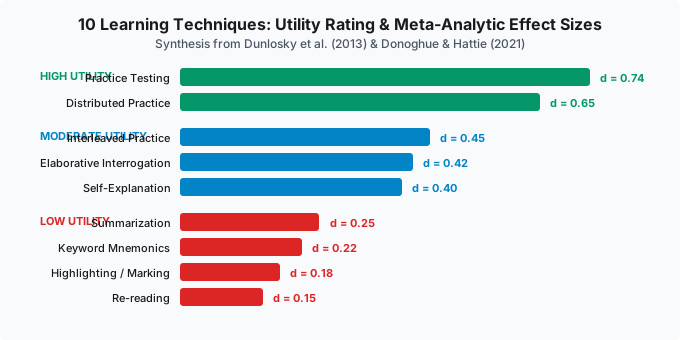
Students and professionals spend thousands of hours studying, yet cognitive psychological research demonstrates that the most common learning habits are often the least effective. In an authoritative landmark review published by the Association for Psychological Science, Dunlosky, Rawson, Marsh, Nathan, and Willingham (2013) evaluated ten widely used learning techniques against rigorous empirical criteria. They categorized each technique into high, moderate, or low utility based on its demonstrated generalizability across diverse student populations, learning materials, and testing formats.
Subsequent quantitative validation by Donoghue and Hattie (2021)—synthesizing 242 studies across more than 100,000 participants—substantiated Dunlosky’s qualitative tiers, showing an overall mean effect size of $d = 0.56$ while revealing massive variance between high-utility strategies and passive habits:
| Technique | Description | Dunlosky Utility Rating | Meta-Analytic Effect Size ($d$) | Generalizability Across Domains |
|---|---|---|---|---|
| Practice Testing | Self-testing or generating answers from memory | High | 0.74 | Robust across ages, materials, and test delays |
| Distributed Practice | Spacing study sessions across separate intervals | High | 0.71 | Universal benefits for facts, skills, and concepts |
| Elaborative Interrogation | Generating explanations for why stated facts are true | Moderate | 0.58 | Requires adequate baseline prior knowledge |
| Self-Explanation | Explaining how new information relates to known facts | Moderate | 0.55 | Effective for procedural and problem-solving steps |
| Interleaved Practice | Mixing distinct categories or problem types | Moderate | 0.45 | Excellent for math and perceptual discrimination |
| Summarization | Writing distillations of texts or presentations | Low | 0.44 | Highly dependent on explicit summary training |
| Keyword Mnemonic | Associating foreign words with phonetic imagery | Low | 0.45 | Fragile; narrow utility for isolated vocabulary |
| Imagery for Text | Forming mental pictures while reading text | Low | 0.46 | Limited to concrete narrative prose |
| Re-reading | Re-studying text passages after an initial reading | Low | 0.36 | High time cost; minimal delayed retention |
| Highlighting / Underlining | Marking text passages while reading | Low | 0.28 | Negligible advantage over unguided reading |
How were the techniques rated?
To establish these utility tiers, Dunlosky and colleagues did not merely examine whether a strategy could produce a statistically significant score increase in a sterile laboratory setting. Instead, they evaluated techniques through four strict dimensions of generalizability:
- Learning Conditions: Does the technique function effectively during independent self-study without constant instructor supervision, varied group sizes, and differing study-test intervals?
- Student Characteristics: Does the strategy benefit learners across broad age ranges, varying cognitive abilities, and differing levels of baseline prior knowledge?
- Materials: Can the technique be applied successfully to diverse materials—from foreign language vocabulary and historical dates to intricate mathematical theorems and philosophical arguments?
- Criterion Tasks: Does the intervention enhance memory on diverse assessment formats, including cued recall, multiple-choice, essay synthesis, and novel problem-solving transfer?
When evaluated through the science of learning such as learning techniques ranked by evidence, only two techniques met all four benchmarks across hundreds of independent empirical trials: practice testing and distributed practice.
What are the high-utility techniques?
The two strategies awarded top honors by cognitive psychologists fundamentally alter the cognitive mechanics of how memories are consolidated:
1. Practice Testing (Retrieval Practice)
Rather than treating testing solely as an administrative evaluation tool, cognitive science proves that retrieval is an exceptionally potent learning event. Actively producing an answer from long-term memory strengthens neural associative pathways and protects against future decay. Implementing systematic active recall through flashcards, practice quizzes, or the blank-page protocol produces retention gains ranging from 30% to 50% over passive re-reading on delayed assessments ($d = 0.74$).
However, modern cognitive architecture and educational coaches like Dr. Justin Sung highlight a critical nuance that mainstream “studygram” culture routinely overlooks: flashcards preserve retention; they do not build comprehension. When students fall into the trap of making thousands of atomic Anki cards before establishing deep structural schemas, active recall degenerates into brute-force rote memorization. Pulling isolated facts out of memory will keep those facts alive, but if you do not understand the underlying cause-and-effect relationships, knowledge remains brittle. On complex, novel exam questions, flashcard-only learners experience sudden cognitive collapse because their memory holds isolated facts rather than an integrated conceptual web. High-utility practice testing must succeed—not replace—deep structural encoding.
2. Distributed Practice (Spaced Repetition)
Distributing study sessions across time rather than consolidating them into a single marathon session forces the cognitive architecture to reconstruct memory representations after partial forgetting has occurred. The spacing effect enables biological memory consolidation between sessions and embeds memory traces within varied environmental and cognitive contexts, producing dramatically higher delayed recall for identical total practice time ($d = 0.71$).
What are the moderate-utility techniques?
Three cognitive strategies demonstrated substantial educational power but were categorized as moderate utility because their effectiveness depends heavily on task structure and learner characteristics:
- Elaborative Interrogation ($d = 0.58$): Involves prompting yourself to ask “Why is this fact true?” or “Why does this result make sense given what I already know?” This strategy forces deep semantic integration, but its utility drops sharply when novices lack sufficient baseline prior knowledge to construct plausible explanations.
- Self-Explanation ($d = 0.55$): Requires learners to explain each procedural step of an exemplar problem or connect incoming statements to preceding paragraphs. It is particularly effective for multi-step algorithmic problem-solving in physics and computer science, though it demands substantial working memory capacity.
- Interleaved Practice ($d = 0.45$): Instead of practicing all problems of type A before moving to type B (blocked practice), interleaving mixes problem categories unpredictably. This forces learners to practice diagnostic categorization—deciding which mathematical formula or principle applies to a given problem. While interleaving causes short-term frustration, it reliably enhances delayed diagnostic accuracy.
For independent learners navigating complex professional topics, mastering the operational nuances of these high- and moderate-utility techniques is critical. Enrolling in a structured teach yourself course provides actionable frameworks to convert these abstract cognitive principles into systematic, repeatable self-education habits.
What are the low-utility techniques?
Five widespread study practices were classified as low utility by Dunlosky and colleagues. Critically, “low utility” does not mean these strategies produce zero cognitive benefit; rather, it indicates that they yield poor returns on time invested, fail to generalize across diverse domains, or require extensive scaffolding that most independent learners do not receive:
- Highlighting and Underlining ($d = 0.28$): The most ubiquitous student study strategy produces near-zero benefit over passive reading. Highlighting frequently induces an illusion of competence: learners mistake the physical act of marking a sentence with fluorescent ink for cognitive comprehension. Furthermore, marking isolated sentences can impede macro-level conceptual integration by drawing excessive attention to atomized facts.
- Re-reading ($d = 0.36$): Reading a chapter a second time yields a modest short-term familiarity boost, but this familiarity decays rapidly over days. Re-reading feels deceptively fluent because the eyes glide easily over previously seen text, blinding the learner to gaps in actual retrieval capability.
- Summarization ($d = 0.44$): While high-quality summarization fosters deep structural comprehension, untrained learners routinely produce superficial, verbatim copying of textbook excerpts. Without explicit instruction on how to extract macro-structures, summarization consumes enormous time with minimal retention payoff.
- Keyword Mnemonic ($d = 0.45$): Effective for associating isolated foreign vocabulary terms with concrete acoustic keywords, but highly fragile over long retention intervals and entirely unsuited for abstract conceptual systems.
- Imagery for Text ($d = 0.46$): Mentally visualizing prose improves memory for vivid, descriptive narratives, but fails completely when applied to abstract technical manuals, mathematical proofs, or theoretical expositions.
What limits the ranking?
While Dunlosky’s ranking provides an essential evidence-based taxonomy, consumers of educational science must respect its methodological boundary conditions:
- Surface vs. Deep Transfer Outcomes: Much of the empirical literature in cognitive psychology measures retention through cued recall or multiple-choice exams. While practice testing and spacing reliably enhance delayed recall, higher-order creative synthesis often demands complementary conceptual mapping and hands-on exploratory project work.
- Prior Knowledge Interactions: Novices and experts interact with learning techniques differently. A novice attempting elaborative interrogation on an unfamiliar domain may generate plausible misconceptions, whereas an expert leverages extensive schemas to construct sophisticated mental models.
- Task Context: A strategy rated low utility in isolation—such as highlighting or text annotation—can become moderately useful when explicitly employed as a preparatory step to identify key concepts for flashcard retrieval construction.
Why do students rely on lower-utility techniques?
If cognitive science has conclusively demonstrated that retrieval and spacing outperform re-reading and highlighting, why do the vast majority of students and professionals continue to rely on the least effective strategies?
The answer lies in cognitive illusions of fluency. When a learner re-reads a highlighted textbook chapter, the perceptual processing is effortless: the words look familiar, the concepts feel intuitive, and the cognitive system registers minimal strain. Metacognitive research by Karpicke, Butler, and Roediger (2009) proved that learners consistently interpret this subjective fluency as evidence of mastery.
Conversely, high-utility techniques like practice testing and interleaving feel halting, slow, and effortful. Because retrieving an answer from memory feels difficult, learners mistakenly conclude that the technique is failing. In educational practice, this disconnect between subjective feeling and objective retention drives students toward comfortable, low-utility habits. This cognitive trap is further reinforced by the widespread learning styles myth, which erroneously encourages learners to seek comfortable instructional modalities rather than engaging in the effortful cognitive friction that genuine learning requires.
Does the ranking apply to every learner and goal?
No single cognitive hierarchy applies universally without regard to contextual constraints. The utility rankings established by Dunlosky and colleagues describe probabilistic performance across controlled educational settings. When designing an optimal personal curriculum, you must adapt these principles to your specific operational goals:
- For Factual and Procedural Retention: Strictly prioritize high-utility practice testing and spaced repetition schedules.
- For Diagnostic Discrimination and Problem-Solving: Integrate moderate-utility interleaved practice and self-explanation protocols.
- For Initial Text Processing: Use low-utility techniques like skimming or light annotation strictly as transient preparatory mechanisms, never as final study methods.
To construct a comprehensive personal strategy that harmonizes these techniques into a cohesive framework, explore our complete blueprint of learning strategies such as learning techniques ranked by evidence.
References & Scientific Evidence
- (2013).Improving students' learning with effective learning techniques: Promising directions from cognitive and educational psychology.
- (2021).A meta-analysis of ten learning techniques. DOI: 10.3389/feduc.2021.581216
- (2009).Metacognitive strategies in student learning: Do students practise retrieval when they study on their own?.
- (2006).Test-enhanced learning: Taking memory tests improves long-term retention.
- (2006).Distributed practice in verbal recall tasks: A review and quantitative synthesis.