Learning Styles: Do They Exist? What the Research Says

What Are Learning Styles?
The concept of “learning styles” posits that individuals differ reliably in how they process, internalize, and acquire information, and that instruction must match each individual’s preferred sensory or cognitive style to maximize learning. The most widely adopted commercial taxonomy is the VARK framework developed by Neil Fleming in 1995, which categorizes students into four sensory categories: Visual, Auditory, Read/Write, and Kinesthetic.
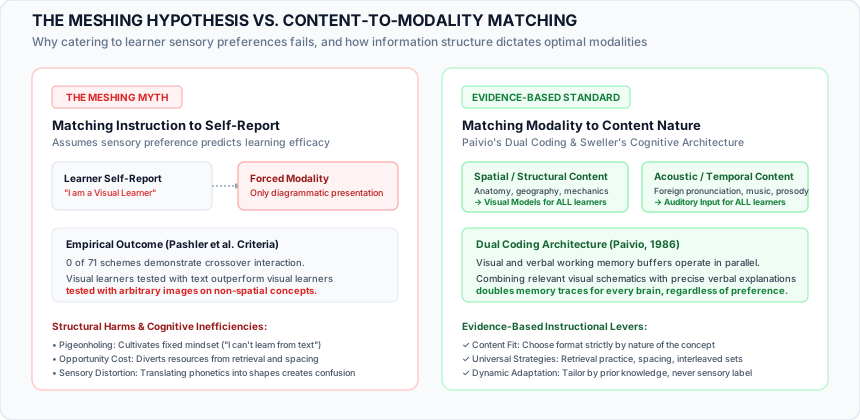
In practical educational settings, this theory takes the form of the meshing hypothesis (also termed the matching hypothesis): the empirical assertion that instructional effectiveness improves when presentation format matches a student’s self-reported learning style. Proponents argue that “visual learners” should be taught with diagrams, graphic organizers, and color-coded presentations; “auditory learners” with lectures, podcasts, and acoustic repetition; and “kinesthetic learners” through tactile manipulatives, physical gesture, and bodily movement.
Yet cognitive psychology draws a sharp, non-negotiable distinction between a subjective cognitive preference and an objective cognitive ability. While surveys consistently prove that learners express strong, sincere preferences for how they prefer to receive information, preference is not ability. Enjoying a visual layout or preferring to listen to audio narration does not mean an individual’s working memory processes semantic content more effectively through that sensory channel. As systematic reviews have demonstrated, there are at least 71 distinct, competing classification models of learning styles in the educational literature (Coffield et al., 2004), creating a sprawling marketplace of incompatible typologies that lack empirical grounding.
What Does the Empirical Research Show?
In 2008, the Association for Psychological Science commissioned an independent, exhaustive scientific review led by cognitive psychologist Harold Pashler, alongside Mark McDaniel, Doug Rohrer, and Robert Bjork (Psychological Science in the Public Interest). Pashler and colleagues recognized that simply finding that visual learners perform well on visual tests does not prove the meshing hypothesis. To validate the claim scientifically, an experimental study must meet a strict, four-part methodological standard:
- Categorization: Learners must be classified into distinct style groups (e.g., visual vs. verbal) using a validated diagnostic instrument.
- Random Assignment: Participants within each style group must be randomly assigned to receive instruction in either their matched format or an unmatched format.
- Identical Assessment: All participants must complete the exact same final test of learning comprehension.
- Crossover Interaction (Aptitude-Treatment Interaction): The instructional method that proves superior for Group A must prove inferior for Group B. If visual presentation improves test scores for all students regardless of their self-reported style, the meshing hypothesis fails.
Pashler’s team surveyed decades of experimental literature and discovered that the vast majority of studies published in favor of learning styles failed basic methodological rigor. Of the few studies that employed acceptable experimental designs, virtually none showed the required crossover interaction. Subsequent rigorous trials confirmed this absence of effect. Rogowsky, Calhoun, and Tallal (2015) tested educated adults classified as auditory or visual learners using standardized comprehension testing and found no statistically significant interaction between learner preference and instructional modality. Whether learners received an audiobook or written e-text, comprehension depended on reading aptitude and text difficulty, not sensory matching.
In their monumental systematic critique, Frank Coffield and colleagues (2004) reviewed 71 distinct commercial learning style models—including Dunn and Dunn, Kolb’s Learning Style Inventory, Gregorc’s Style Delineator, and Fleming’s VARK—and concluded that the field is characterized by poor reliability, lack of construct validity, and unsubstantiated commercial claims. In classroom practice, prioritizing superficial sensory modalities distracts educators from the proven mechanics of active vs passive learning explained, which require genuine cognitive effort rather than passive reception.
Why Do 90%+ of People Believe in Learning Styles?
International surveys across the United Kingdom, Netherlands, Turkey, Greece, and China consistently reveal that over 90% of school teachers, university lecturers, and corporate trainers believe that instruction should be tailored to individual learning styles. In Neuromyths: Debunking False Ideas About the Brain, Tracey Tokuhama-Espinosa categorizes learning styles as one of the most resilient neuromyths in modern education. Its persistence is sustained by powerful cognitive biases, linguistic conveniences, and commercial incentives:
- The Seductive Allure of Neuroscience: Weisberg, Keil, Goodstein, Rawson, and Gray (2008) demonstrated that adding mathematically irrelevant neuroscience jargon (such as “frontal lobe processing” or “synaptic pruning”) makes bad psychological explanations significantly more satisfying and convincing to laypeople. When learning styles are marketed as “brain-based learning,” educators assume biological rigor where none exists.
- The Levels-of-Analysis Fallacy: John Bruer (1997) and Jeffrey Bowers (2016) demonstrated that neuroscience measures biological structures (synapses, action potentials, blood oxygenation), whereas education operates at the level of mind, behavior, and social interaction. Claiming that structural brain differences imply distinct educational “modalities” bridges a chasm that biology does not cross.
- Confirmation Bias and Self-Fulfilling Identity: When learners are labeled “visual” or “kinesthetic,” they attend selectively to experiences that confirm the label. A student who struggles with an algebra lecture attributes the difficulty to their “non-auditory style” rather than to working memory overload or insufficient prerequisite practice.
- Commercial and Institutional Incentives: As Jon Tibke highlights in Why the Brain Matters: A Teacher Explores Neuroscience, an entire commercial industry sells proprietary surveys, teacher certifications, and branded diagnostic kits. Educational institutions purchase these programs because they offer simple, concrete answers to the complex challenge of student differentiation.
Crucially, learning style labeling carries measurable cognitive harms. When individuals pigeonhole themselves into rigid categories, they cultivate a fixed mindset: “I’m a visual learner, so I cannot read long academic papers or absorb technical lectures.” Furthermore, catering to preferences consumes enormous instructional energy that could otherwise be dedicated to high-utility cognitive interventions. Investigating why traditional school methods often fail learners reveals that superficial structural classifications frequently replace authentic pedagogical diagnostic support.
What Works Instead: Content Matching & Dual Coding
Abandoning the meshing hypothesis does not mean that all learners are identical, nor does it suggest that instructional modality is irrelevant. Rather, modern cognitive science demonstrates that instructional modality must be matched to the nature of the content, not the subjective preference of the learner:
1. Content-to-Modality Alignment
Every body of knowledge possesses an intrinsic representational structure. Spatial, structural, and topological information—such as anatomical pathways, geographic boundaries, mechanical gear trains, or architectural blueprints—is intrinsically spatial and should be presented with high-clarity diagrams for all learners. Conversely, acoustic, temporal, and phonetic information—such as foreign language pronunciation, orchestral timbre, or poetic meter—must be delivered auditorily to all learners. Forcing an arbitrary visual chart onto musical chord progressions or translating a geographic map into purely verbal audio descriptions creates severe cognitive friction.
2. Paivio’s Dual Coding Theory
Rather than isolating students into single sensory silos, cognitive psychologist Allan Paivio (1986) established that the human cognitive architecture possesses two separate, complementary working memory subsystems: a verbal channel (the phonological loop) and a non-verbal visual channel (the visuospatial sketchpad). Presenting relevant explanatory diagrams alongside synchronized verbal explanations allows the brain to encode information through both channels simultaneously. This synergistic integration constructs dual memory traces—an additive effect that significantly outperforms single-modality instruction for every healthy human brain.
3. Universal Cognitive Multipliers
Instead of exhausting finite study time designing idiosyncratic sensory formats, learners and educators achieve vastly superior retention by applying universal, evidence-tested learning mechanisms:
- Retrieval Practice: Actively recalling information from memory rather than re-reading or re-highlighting notes.
- Distributed Spacing: Spreading study sessions across expanding time intervals to interrupt forgetting.
- Interleaved Problem Sets: Mixing distinct problem types within a single practice session to develop deep categorization skills.
- Diagnostic Formative Feedback: Pinpointing precise conceptual errors and schema gaps rather than attributing failure to sensory mismatch.
The 5-Point Neuromyth Diagnostic Audit
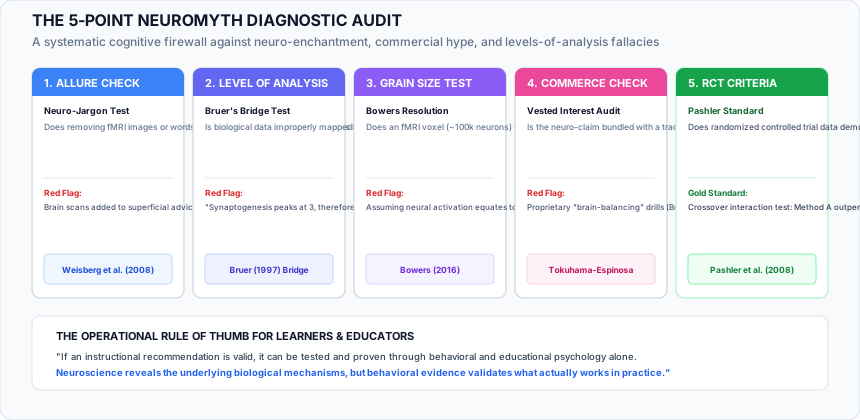
To protect self-directed learners, educators, and curriculum designers from commercial pseudo-neuroscience, Tracey Tokuhama-Espinosa and Jon Tibke outline a systematic diagnostic firewall. Whenever evaluating an educational product or self-help claim that invokes the brain, apply these five diagnostic filters:
- The Seductive Allure Filter: Mentally strip away all brain terminology, fMRI imagery, and decorative references to neurons. Does the core behavioral claim stand on its own empirical evidence? If an explanation only sounds persuasive when accompanied by a brain scan, it is an allure effect (Weisberg et al., 2008).
- The Level-of-Analysis Test: Ask whether cellular or metabolic observations (e.g., synaptogenesis, hemisphere lateralization) are being improperly generalized into complex behavioral prescriptions. As John Bruer established, neuroscience cannot tell a teacher how to teach a child to read without the mediating science of cognitive psychology.
- The Grain-Size Mismatch Check: Consider whether the resolution of the neuroscience matches the resolution of the classroom. An fMRI voxel averages metabolic activity across roughly 100,000 neurons over several seconds. It cannot resolve real-time conceptual comprehension, syntactic processing, or pedagogical pacing (Bowers, 2016).
- The Commercial Incentive Audit: Check whether the claim is linked to a proprietary, trademarked product, assessment instrument, or certified franchise (e.g., Brain Gym, BrainHQ commercial claims, VARK copyrighted questionnaires). Legitimate principles of cognitive science—retrieval, spacing, dual coding—are public scientific discoveries, not proprietary licensing packages.
- The Crossover RCT Standard: Demand randomized controlled trial evidence demonstrating that the technique produces an aptitude-treatment crossover interaction. If a method does not demonstrate superior measurable retention under controlled conditions, it remains a hypothesis, not an evidence-based practice.
What Does This Mean for Teachers, Parents, and Self-Directed Learners?
Recognizing that learning styles are an empirical myth liberates educators and students from artificial constraints. Contrasting popular misconceptions with the best learning techniques shows that what learners require is not sensory pampering, but systematic instruction tailored to their current level of prior knowledge.
For teachers and corporate trainers, abandoning learning styles eliminates dozens of hours wasted on designing parallel visual, auditory, and kinesthetic versions of the same lesson. That instructional capital can be redirected to formative assessment, scaffolding complex tasks, and providing targeted diagnostic feedback. In any curriculum, instruction should deploy multiple sensory modalities—not because different students require different channels, but because combining complementary representations deepens conceptual understanding for everyone.
For self-directed learners and students, letting go of style labels dismantles debilitating self-imposed barriers. Struggling with a dense textbook does not mean you lack an “auditory brain”; it indicates that you need better reading strategies, active self-explanation, or prerequisite schema building. Rather than asking “Does this material fit my learning style?”, ask: “What does this specific concept require—a schematic diagram, a verbal explanation, or deliberate physical practice?” Align your study methods to the inherent logic of the subject matter, and rely on the foundational, evidence-based learning strategies such as learning styles critiques to direct your efforts where cognitive returns are highest.
References & Scientific Evidence
- (2008).Learning styles: Concepts and evidence. DOI: 10.1111/j.1539-6053.2009.01038.x
- (2004).Learning styles and pedagogy in post-16 learning: A systematic and critical review.
- (2018).Neuromyths: Debunking False Ideas About the Brain.
- (2019).Why the Brain Matters: A Teacher Explores Neuroscience.
- (2015).Matching style to modality: An experimental test of the learning styles hypothesis. DOI: 10.1037/edu0000030
- (2015).The scientific status of learning styles theories. DOI: 10.1177/0098628315589505
- (2008).The seductive allure of neuroscience explanations. DOI: 10.1162/jocn.2008.20040
- (1986).Mental Representations: A Dual Coding Approach.