Retrieval Practice: What It Is, Why It Works and How to Use It

What is retrieval practice?
Retrieval practice—frequently termed the testing effect or test-enhanced learning—is the deliberate act of recalling information from memory rather than passively reviewing, highlighting, or re-reading it. Whenever you answer a practice quiz, explain an idea without looking at your notes, write down everything you remember on a blank page, or test yourself with flashcards, you are engaging in retrieval practice.
In traditional schooling, testing is almost universally treated as an assessment tool—a summative instrument designed to evaluate what a student has already memorized. Cognitive science reveals a vastly more profound truth: retrieval practice is a learning strategy, not an assessment strategy. As cognitive scientist Pooja Agarwal and educator Patrice Bain (Powerful Teaching) emphasize, retrieval practice requires no grading, no points, and no high-stakes accountability. It is an ungraded, low-stakes opportunity for learners to pull knowledge out of their minds to consolidate it.
Agarwal and Bain illustrate this distinction with the baking analogy:
- Retrieval practice is the active process of learning to bake—cracking eggs, measuring flour, and adjusting ingredients while embracing errors as valuable diagnostic data.
- Formative assessment is like inserting a toothpick into the cake while it bakes to inspect its internal state.
- Summative assessment is slicing and evaluating the finished cake at the end of the process.
In everyday life, humans rely on retrieval practice continuously without realizing it: driving a familiar commute without GPS navigation, executing complex button combos in a video game, playing a memorized musical passage, or recalling a colleague’s name. Transferring this natural biological mechanism into deliberate study habits transforms academic and professional competence.
Why does retrieval practice work?
The cognitive and neurobiological mechanisms explaining why pulling information out of memory is fundamentally superior to cramming information in rest on five foundational principles:
1. Memory Reconsolidation and Trace Restructuring
Retrieving an item from long-term memory destabilizes the memory trace, initiating an active neurobiological reconsolidation process. Every time you bring knowledge to mind, the neural circuit is not merely read out like a digital file; it is structurally modified, consolidated, and integrated into existing cognitive schemas, making the trace more resilient against biological decay.
2. The New Theory of Disuse (Storage Strength vs. Retrieval Strength)
Cognitive psychologists Robert and Elizabeth Bjork formulated the New Theory of Disuse, which proves that every memory trace possesses two independent, dynamically interacting strengths:
- Storage Strength: How deeply consolidated and interconnected an item is in long-term memory (its long-term durability). Storage strength never decreases; once deeply encoded, traces endure.
- Retrieval Strength: How easily and immediately accessible an item is right now (its momentary fluency). Retrieval strength fades rapidly with time and distraction.
Crucially, these two dimensions are dissociated: high retrieval strength can mask near-zero storage strength (such as the superficial fluency experienced while re-reading a textbook chapter). When retrieval strength is high, studying yields minimal storage strength gains. Conversely, when retrieval strength is low—after a delay or a period of partial forgetting—the struggle to retrieve forces the brain to expend effort, generating massive gains in permanent storage strength. Retrieval practice works precisely because it forces the brain to overcome low retrieval strength.
3. Elaborative Search Networks and Multi-Route Access
When you attempt to recall a concept without looking at the answer, your brain activates a broad search network across related memories and concepts. Even when initial retrieval requires mental strain, this activated semantic network builds multiple alternative retrieval pathways, ensuring that the target information can be accessed from different contextual cues in the future.
4. Calibrating Metacognitive Accuracy
Passive re-reading creates an immediate illusion of competence: because the text is open in front of your eyes, your brain mistakes visual familiarity for genuine mastery. Testing forces an honest diagnostic mirror, instantly exposing knowledge gaps and protecting learners from the dunning kruger effect.
5. Stress Inoculation and Anxiety Reduction
Educational researchers have proven that regular, low-stakes retrieval practice desensitizes the psychological stress response associated with evaluative performance. By repeatedly experiencing the sensation of pulling knowledge from memory in a safe, ungraded setting, learners build stress-resistant memory traces and experience dramatically lower test anxiety on formal examinations.
To explore how active retrieval fits within broader cognitive frameworks, explore our guide on active learning strategies.
What types of retrieval practice are there?
Retrieval practice is not limited to multiple-choice quizzes. It spans a continuum of cognitive formats varying in cue strength and generative difficulty:
- Free Recall & The “Brain Dump” Method: Writing or sketching everything you can remember about a topic onto a blank sheet of paper without looking at notes. Free recall requires the highest degree of unassisted cognitive search and yields the largest mnemonic gains.
- Cued Recall & Flashcards: Using prompts, questions, or flashcards where an explicit stimulus prompts the retrieval of target knowledge. To maximize efficiency with this method, review our detailed protocol on how to make effective flashcards.
- The “Two Things” Routine: A quick, three-minute pause during or at the conclusion of a study session where the learner writes down exactly two key takeaways from memory before proceeding.
- The “Brain – Book – Buddy” Protocol: Formulated by educator Blake Harvard, this sequence trains learners to manage retrieval difficulty:
- Brain: Attempt to retrieve the concept entirely from memory first.
- Book: If recall fails, consult notes or source texts to locate the exact missing link.
- Buddy: If confusion persists, consult an instructor or peer for conceptual clarification.
- Diminishing Cues Retrieval Practice (Fading Scaffolds): Beginning with structured hints (such as partial outlines or conceptual cues) and systematically removing prompts across consecutive practice trials until retrieval is unassisted.
- Deliberate vs. Naive Retrieval: As educational researchers Fisher, Frey, and Almarode emphasize, naive retrieval practice consists of mindless busywork (such as repeatedly copying a vocabulary word ten times without thought). Deliberate retrieval is targeted, focused on identified conceptual deficits, and paired with immediate corrective analysis.
How do you do retrieval practice step by step?
A scientifically validated retrieval practice routine follows four concrete phases:
Step 1: Initial Conceptual Encoding
Study a concept, chapter, or problem until baseline comprehension is established. Crucially, retrieval practice cannot function on pure ignorance or superficial acquaintance; you must first understand the structural logic before testing your recall. As learning coaches and cognitive scientists emphasize, flashcards preserve retention; they do not build comprehension. Brute-forcing flashcard decks without prior non-linear schema encoding leads to cognitive burnout, fragile understanding, and failure when novel questions alter surface features. Always build a coherent mental model first through relationship mapping or self-explanation, then deploy retrieval to preserve that understanding against decay.
Step 2: The Deliberate Delay
Introduce a brief temporal delay (from a few minutes to a day) between initial encoding and your first retrieval attempt. If you test yourself immediately after reading, you are merely querying working memory rather than pulling from long-term storage. Coupling retrieval intervals with time delays is detailed in our guide on spaced repetition explained.
Step 3: Effortful Recall Without Peeking
Attempt to recall, write out, diagram, or apply the concepts completely from memory. Do not peek at the answers when stuck. While artificial intelligence tools can generate custom diagnostic quizzes, the cognitive effort of recall must remain entirely with the learner—explore practical prompts in our collection of chatgpt prompts for studying.
Step 4: Diagnostic Feedback & Successive Relearning
Check your output against the primary source immediately. Correct all factual inaccuracies, note missing conceptual links, and verify the rationale behind every error. Cognitive psychologists Katherine Rawson and John Dunlosky established that successive relearning—retrieving an item until recalled correctly, followed by spaced re-testing across subsequent days—produces a 20 percent performance advantage over ordinary restudy while cementing durable comprehension.
To integrate retrieval practice into a complete, daily self-directed curriculum, explore our structured self-learning course.
What does the research show?
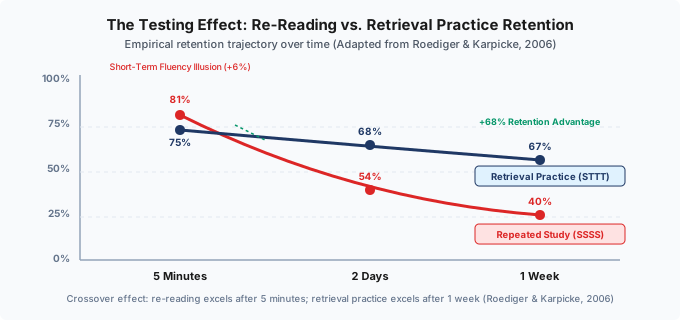
The empirical foundation for retrieval practice spans more than a century of rigorous experimental science:
- Pioneering Research & The Landmark Crossover: Experimental investigation began with Edwina Abbott’s 1909 study analyzing recall factors in learning. In 1989, John Glover published “The Testing Phenomenon: Not Gone but Nearly Forgotten,” lamenting that educators had overlooked a proven cognitive strategy. In 2006, Henry Roediger and Jeffrey Karpicke published their definitive trial: students studying passages repeatedly (SSSS) scored slightly higher after five minutes (81% vs. 75%), but after one week, students who practiced retrieval (STTT) retained 67% compared to just 40% in the study group—a massive long-term advantage.
- Large-Scale Meta-Analyses:
- Rowland (2014) synthesized 159 studies, confirming a robust overall testing effect ($g = 0.50$).
- Adesope, Trevisan, and Sundararajan (2017) analyzed 272 effect sizes across 118 articles, confirming an overall effect size of $g = 0.61$ over non-testing controls.
- Yang, Luo, Vadillo, Yu, and Shanks (2021) synthesized 222 classroom studies, showing that regular low-stakes quizzing elevated course exam performance by an average of $g = 0.55$.
- Direct Superiority Over Concept Mapping: In Science, Karpicke and Blunt (2011) compared retrieval practice with elaborative concept mapping. Despite learners predicting that concept mapping would produce superior retention, retrieval practice outperformed elaborative study on both factual recall and high-level inferential reasoning tests by a wide margin.
- Classroom Trials and Letter-Grade Increases: Pooja Agarwal conducted a 1.5-year longitudinal investigation in real middle-school social studies classrooms with Patrice Bain. Ungraded retrieval quizzes covered only one-third of the syllabus. On final summative unit exams, students scored one full letter grade higher (e.g., jumping from a C to an A) on the retrieved material compared to concepts taught via conventional lecture and re-reading.
- Universal Efficacy and Working Memory Scaffolding: Research demonstrates that retrieval practice benefits learners across all age groups and demographics. Notably, Agarwal, Finley, Rose, and Roediger (2017) confirmed that students with lower working memory capacity experience the greatest relative learning gains from retrieval practice, as frequent retrieval automates component knowledge and frees scarce working memory resources.
What mistakes reduce its benefit?
Learners frequently undermine retrieval practice by falling into five common implementation pitfalls:
- Testing Immediately After Reading: Testing yourself within seconds of closing a book queries short-term phonological buffers rather than long-term memory, generating zero desirable difficulty.
- Skipping Corrective Feedback: When learners retrieve incorrect answers and fail to verify accuracy against primary sources, they risk stabilizing inaccurate information in long-term memory (Rawson & Dunlosky, 2007).
- Checking the Answer Prematurely: Peeking at the answer after a few seconds of hesitation short-circuits the memory search process, depriving the brain of the reconsolidation benefit.
- Using Heavy Surface Hints Instead of Weak Conceptual Cues: As researchers Ball and Fairlamb (The Scaffolding Effect) note, hints that provide surface clues (such as “it rhymes with…” or “the first letter is P”) eliminate cognitive struggle without supporting semantic understanding. Scaffolds should provide weak conceptual cues only after appropriate wait time.
- Turning Retrieval into High-Stakes Assessment: Attaching grades or evaluative penalties to retrieval practice triggers evaluative stress, inducing cognitive interference and discouraging exploratory error correction.
How does retrieval practice differ from re-reading?
The structural difference between passive re-reading and active retrieval practice is the difference between passive sensory exposure and active cognitive reconstruction:
| Dimension | Passive Re-Reading | Retrieval Practice |
|---|---|---|
| Cognitive Mechanism | Passive sensory scanning; perceptual familiarity | Active long-term memory search & neural reconsolidation |
| Subjective Sensation | Smooth, fluent, deceptively effortless | Mentally demanding, effortful, slow |
| Metacognitive Impact | Inflates illusions of competence | Calibrates an honest mirror of knowledge gaps |
| Short-Term Retention (5 Min) | High (captures immediate working memory) | Moderate to high |
| Long-Term Retention (1 Week+) | Rapid decay (steep forgetting curve to ~40%) | Durable synaptic stabilization (~67%+ retained) |
| Knowledge Transfer | Surface-level matching and literal recognition | Deep conceptual flexibility and novel application |
To understand how retrieval forms the foundational cornerstone of comprehensive self-directed study, explore our comprehensive framework on learning how to learn.
Why does retrieval feel harder than re-reading, and why does that matter?
Learners routinely avoid retrieval practice because it feels subjectively difficult, slow, and frustrating. When reading a passage repeatedly, fluent visual recognition tricks the brain into assuming that the information is permanently mastered. In Uncommon Sense Teaching, Barbara Oakley, Beth Rogowsky, and Terrence Sejnowski illustrate this with a common student experience: a learner looks at an open textbook explanation and thinks “I’ve got it!” In reality, the information is held only in transient working memory—it has not formed durable neural links in long-term storage.
Cognitive psychologists Elizabeth and Robert Bjork term this phenomenon a desirable difficulty. Conditions that make initial learning feel effortful and challenging often trigger the very neurobiological processes that support durable long-term retention and flexible transfer.
Conversely, conditions that make learning feel effortless and smooth typically support only transient, superficial performance that vanishes within days. As British cognitive psychologist Alan Baddeley (Memory) observes, students systematically judge retrieval-based learning to be their least effective study technique, even immediately after experiments prove it doubled their retention. Subjective difficulty during recall is not an indicator of failure; it is the biological signature of neural consolidation taking place.
Does retrieval practice work for complex subjects?
Yes. A common misconception is that practice testing only benefits rote memorization of simple facts, vocabulary, and dates.
Comprehensive meta-analyses by Pan and Rickard (2018) and Butler (2010) rigorously debunk this myth. When retrieval prompts require learners to explain causal mechanisms, compare competing theoretical perspectives, or apply principles to novel case studies, retrieval practice generates large, robust transfer effects ($g > 0.40$) on higher-order inferential and problem-solving assessments.
As Agarwal and Bain emphasize through their HOT (Higher-Order Thinking) framework, teachers and self-directed learners should deliberately shift from simple factual recall (“What is the concept?”) to mechanistic and application prompts (“Why does this occur?” and “How would you solve this scenario?”). Active reconstruction stabilizes the underlying conceptual schemas required for advanced analytical reasoning.
References & Scientific Evidence
- (2006).Test-enhanced learning: Taking memory tests improves long-term retention.
- (2019).Powerful Teaching: Unleash the Science of Learning.
- (2011).Making things hard on yourself, but in a good way: Creating desirable difficulties to enhance learning.
- (2014).The effect of testing versus restudy on retention: A meta-analytic review of the testing effect.
- (2021).Testing (quizzing) boosts classroom learning: A systematic and meta-analytic review.
- (2017).Rethinking the use of tests: A meta-analysis of practice testing.
- (2011).Retrieval practice produces more learning than elaborative studying with concept mapping.
- (2018).Transfer of test-enhanced learning: Meta-analytic review and synthesis.
- (2010).Repeated testing produces superior transfer of learning relative to repeated studying.
- (2013).Improving students' learning with effective learning techniques.