Spaced Repetition: How the Spacing Effect Works and How to Use It

What is spaced repetition?
Spaced repetition—termed distributed practice in cognitive psychology—is the empirical practice of distributing learning and review events across separate time intervals rather than consolidating study into a single, continuous block. When you space your study, the total time dedicated to the material remains identical to a massed study session; only the temporal distribution between exposures is altered.
Hermann Ebbinghaus (1885) discovered this fundamental dynamic over a century ago during his pioneering investigations of human memory. Ebbinghaus observed that memorizing a list of 12 nonsense syllables required 68 massed repetitions in a single day. However, when he distributed the identical practice across three consecutive days, he achieved flawless recall with only 38 repetitions—reducing total study investment by 44% for an identical learning outcome.
Rather than being an arbitrary feature of human schooling, the spacing effect is an evolutionarily ancient property of biological memory systems. Controlled trials by Gerbier and Toppino (2015) demonstrate that identical distributed practice advantages manifest across honeybees, fruit flies, and rodents. As cognitive psychologist Alan Baddeley observed: “As far as learning is concerned, ‘little and often’ is an excellent precept.”
In 1991, the National Research Council designated distributed practice “one of the most reliable phenomena in human experimental psychology.” A systematic meta-analysis by Latimier and colleagues (2021) documented a substantial overall effect size of $g = 0.74$ favoring spaced practice over massed instruction across educational settings. As learning researcher Peter Hollins emphasizes, the primary metric of learning efficiency is frequency rather than raw session duration: “Spaced repetition is the concept that 5 minutes a day is far superior for learning and memory than an hour a week.” Reviewing a core concept 10 times across seven days builds enduring synaptic stability that 20 massed exposures in a single weekend cannot match.
How does the spacing effect work?
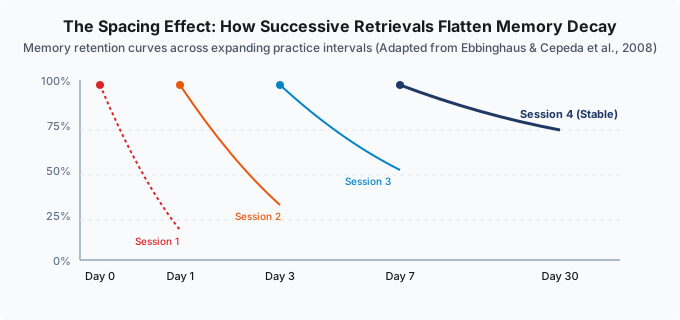
The spacing effect describes the empirical reality that information repeated across temporal gaps is retained substantially longer than identical information presented in rapid, back-to-back succession. Cognitive psychologists and neuroscientists trace this superiority to six converging theoretical mechanisms:
- Deficient Processing (Attention Attenuation): When an item is repeated immediately in massed succession, learners experience high immediate familiarity. As Challis (1993) and Aggleton demonstrate, the cognitive apparatus treats familiar stimuli as already mastered, allocating diminished visual inspection time and minimal metabolic encoding effort. Spaced intervals allow superficial familiarity to fade, forcing the brain to direct full attentional processing to the re-encounter.
- Encoding Variability (Contextual Drift): Formulated by Martin (1968) and Glenberg (1979), this principle states that memories are indexed by the learner’s internal psychological state (mood, alertness) and external environment (setting, lighting, time of day). Massed practice binds an engram to a single, narrow contextual state. Spaced practice distributes study across varying environments, creating a multi-cue associative network that provides multiple independent retrieval pathways during future recall.
- Study-Phase Retrieval & Neural Pattern Reinstatement: When an item reappears after a delay, it prompts an automatic retrieval of the initial memory trace to interpret the recurring stimulus (Thios & D’Agostino, 1976). This reconstructive retrieval actively strengthens the trace. In an fMRI investigation, Xue and colleagues (2010) demonstrated that spaced repetitions produce greater similarity in neural activation patterns across repeated study attempts. The fidelity with which the brain reinstates the original neural activation pattern during spaced retrieval directly predicts delayed memory retention.
- Synaptic Consolidation and Plasticity Saturation: Long-term potentiation (LTP) and structural dendritic remodeling require biological time windows to synthesize proteins and stabilize synaptic connections. As neuroscientists highlight, massed trials occur during cellular refractory periods, saturating plasticity mechanisms and blunting cumulative synaptic gains. Spacing allows uninterrupted biological consolidation—particularly during slow-wave sleep—to solidify traces between sessions.
- Two-Factor Theory (Greene): Cognitive theorist Robert Greene unified study-phase retrieval and encoding variability into an integrated two-factor framework. Factor 1 (study-phase retrieval) operates rapidly, reinforcing access routes in the short term. Factor 2 (encoding variability via contextual drift) operates across longer temporal delays, providing flexible contextual cues. This dual dynamic explains why spacing benefits expand as the retention delay grows from days to months.
- Desirable Difficulty & Bjork’s New Theory of Disuse: Robert and Elizabeth Bjork distinguish between Retrieval Strength (immediate accessibility) and Storage Strength (permanent structural entrenchment). Massed cramming elevates retrieval strength to 100% while imparting almost zero storage strength. Spaced intervals allow retrieval strength to decline. Retrieving an item when access is difficult acts as a potent biological signal that triggers exponential increases in permanent storage strength. As Brown, Roediger, and McDaniel note in Make It Stick: “As you reconstruct learning from long-term memory, as awkward as it feels, you are strengthening your mastery as well as the memory.”
What does the empirical evidence show?
The evidence supporting the spacing effect is among the most comprehensive and deeply replicated in behavioral science. Laboratory experiments, longitudinal trials, and classroom interventions consistently validate its efficacy across diverse task domains.
The Classic Demonstration: Melton (1970)
Arthur Melton provided the classic demonstration of the lag effect—the principle that increasing the temporal separation or number of intervening items between repetitions progressively improves memory. Melton presented word lists where repeated words were separated by 0 to 40 intervening items, testing three presentation speeds (1.3, 2.3, and 4.3 seconds per word):
- Words repeated with zero intervening words (massed repetition) achieved approximately 35% recall at the 4.3-second rate.
- Words repeated with 40 intervening items reached nearly 60% recall—an absolute gain of 25 percentage points and a 71% relative improvement.
- Total study exposure was held strictly constant across conditions (two 4.3-second exposures = 8.6 seconds total). Only the temporal spacing differed.
Long-Term Retention and Trivia: Cepeda et al. (2008)
To determine whether spacing benefits extended beyond brief laboratory intervals to factual knowledge across years, Nicholas Cepeda, Edward Vul, Doug Rohrer, John Wixted, and Harold Pashler (2008) conducted a landmark study with 1,354 participants. Learners studied 32 obscure trivia facts, revisited them at inter-study intervals ranging from 0 to 105 days, and were tested after retention delays of 5, 35, 70, or 350 days.
Cepeda and colleagues revealed a sizable spacing advantage across every retention delay. Regardless of whether final testing occurred one month or one year later, distributed restudy produced dramatically superior factual retention compared to massed study. In an earlier meta-analysis synthesizing 254 verbal memory studies, Cepeda et al. (2006) documented a robust overall effect size of $d = 0.46$ favoring distributed over massed practice.
Longitudinal Vocabulary: Bahrick’s Nine-Year Study
Harry Bahrick and colleagues (1993) conducted an unprecedented nine-year longitudinal investigation tracking the acquisition and retention of foreign language vocabulary across multi-week intervals (14, 28, and 56 days). Over nine years of tracking:
- The 56-day spacing interval produced the highest long-term retention.
- 13 practice sessions spaced 56 days apart yielded retention comparable to 26 sessions spaced 14 days apart.
- Spacing enabled learners to achieve equivalent nine-year retention while cutting total practice sessions in half.
Cross-Domain Efficacy
The spacing effect generalizes across diverse educational and cognitive domains:
- Factual & Verbal Learning: Dunlosky and colleagues (2013) designated distributed practice as one of only two learning techniques receiving the highest utility rating. In delayed tests, spaced study yields 30% to 50% higher recall than massed review.
- Procedural and Motor Skills: Meta-analyses by Donovan and Radosevich (1999) and reviews by Pashler et al. (2007) establish that spacing benefits motor skill execution, athletic routines, and surgical training. Spacing allows offline motor memory consolidation while preventing the physical and cognitive fatigue that degrades massed repetitions.
- Mathematics and Analytical Reasoning: In classroom trials by Rohrer and Taylor (2006, 2025), students solving mathematics problems across distributed weekly problem sets achieved significantly higher delayed exam scores ($g = 0.28$) than peers completing identical problem sets in blocked, massed assignments.
- Inductive Category Learning: Kornell and Bjork (2008) tested whether spacing helped or hindered the induction of artistic styles across distinct painters. Despite 78% of participants intuitively believing that massing paintings by the same artist would help them detect stylistic patterns, spaced presentation across artists yielded substantially superior diagnostic accuracy on novel, unseen paintings ($78%$ vs $64%$).
However, cognitive science establishes an essential boundary condition: David Goodwin (What Are They Thinking?) emphasizes that spacing requires strong initial encoding. If initial instruction is incoherent or incomplete, spacing cannot consolidate a memory trace that was never properly formed. Spaced review reinforces comprehension; it does not replace it.
How long should the review intervals be?
A fundamental challenge for independent learners and educators is determining the optimal gap between practice sessions. Cognitive research reveals that there is no single universal interval. Instead, the optimal inter-study interval (ISI) depends directly on the retention interval (RI)—the time elapsed between the final study session and the ultimate performance test.
In their 1,354-participant study, Cepeda and colleagues (2008) mapped a definitive “temporal ridgeline” of retention. Their data proved that as the desired retention duration increases, the optimal gap between sessions expands:
| Target Retention Delay (RI) | Optimal Inter-Study Interval (ISI) | Recommended Gap Ratio | Example Practical Schedule |
|---|---|---|---|
| 1 Week (7 Days) | 1–2 Days | 20%–30% of delay | Initial study on Monday; review Wednesday |
| 1 Month (30 Days) | 5–7 Days | 15%–20% of delay | Review at Day 1, Day 7, and Day 21 |
| 6 Months (180 Days) | 3–5 Weeks | 10%–15% of delay | Review at Day 2, Day 14, Day 45, and Day 120 |
| 1 Year (365 Days) | 3–4 Weeks | ~10% of delay | Review at Day 2, Day 21, Day 60, and Day 180 |
| 5+ Years (Permanent) | 2–3 Months | ~5% of delay | Review at 1 month, 3 months, 6 months, and annually |
Gaps that are excessively short degenerate into massed practice, offering minimal long-term benefit. Conversely, gaps that are excessively long allow the memory trace to decay past the retrieval threshold, causing complete relearning rather than memory reactivation.
Piotr Wozniak, the creator of SuperMemo and pioneer of algorithmic spaced repetition, articulated the core scheduling tension: “Intervals should be as long as possible to obtain the minimum frequency of repetitions, and to make the best use of the spacing effect—but intervals should be as short as possible so that the knowledge is still remembered.” His foundational progression begins with a review 1 to 2 days after initial acquisition, followed by 1 week, 1 month, and 3 months.
To manage these intervals systematically without software, learners frequently adopt the leitner system, which organizes flashcards into graduated review compartments based on retrieval accuracy. Cards answered correctly advance to less frequent compartments, while errors return immediately to Box 1 for daily review.
Importantly, modern meta-analyses challenge the assumption that review intervals must continually expand. A systematic meta-analysis by Latimier and colleagues (2021) demonstrated that expanding schedules produce an effect size statistically indistinguishable from uniform, equal spacing intervals ($g = 0.034$). While expanding intervals help stabilize fragile items during initial acquisition, fixed equal intervals (e.g., biweekly reviews) deliver identical durability while greatly simplifying schedule logistics.
How to implement spaced repetition in practice
Translating the spacing effect into a reliable daily workflow requires shifting from session duration to distribution frequency.
1. Prioritize Frequency Over Duration
Measure how many times you revisit core ideas across days, not how many continuous hours you log in a single weekend. As Peter Hollins (Super Learning) notes, 10 exposures distributed across seven days produce far more durable memory than 20 massed exposures in a single afternoon. Dedicate 45 minutes daily across five days rather than five hours in a single Saturday marathon.
2. Pair Spacing with Active Retrieval
Spacing passive re-reading improves retention compared to massed reading, but combining spacing with active recall generates the highest retention gains documented in educational psychology. In Powerful Teaching, Pooja Agarwal and Patrice Bain define effective spacing as engaging in retrieval practice multiple times across time. Rather than reviewing summary notes, administer low-stakes practice quizzes, write summaries from memory, or use flashcards. This leverages the testing effect to convert transient recall into permanent storage strength.
3. Interleave Practice Within Spaced Sessions
Do not space review in monolithic blocks of a single topic. When revisiting material, interleave distinct but related problem types, formulas, or historical periods (Rohrer & Taylor, 2006). Interleaving forces the brain to continuously discriminate which strategy applies to which problem, preventing rote mechanical execution and deepening conceptual flexibility.
4. Deploy the “Emergency Cramming” Simulation
When an unavoidable deadline leaves you with only 24 to 48 hours to prepare, you cannot execute multi-week spacing. However, you can simulate distributed benefits across a single day (Hollins):
- Study the core concepts immediately upon waking (e.g., 7:30 AM).
- Conduct a self-quizzing review at noon (12:00 PM).
- Complete a third retrieval session in the late afternoon (4:30 PM).
- Conduct a final review before bedtime (9:30 PM).
- Shuffle the order of materials between sessions to introduce contextual variability.
5. Protect Sleep for Neural Consolidation
Memory consolidation relies heavily on slow-wave sleep and sleep spindles to transfer engrams from the hippocampus to the neocortex (Brown et al., 2014). Spacing practice across days ensures that each review cycle is separated by a period of nocturnal synaptic consolidation. Reviewing challenging concepts for 15 minutes immediately before sleep gives this consolidation process an immediate biological head start.
For self-directed professionals mastering complex technical competencies, orchestrating these distributed review cycles manually can be challenging. A structured framework like the learn how to learn course provides pre-engineered pacing guides and cognitive architectures to operationalize distributed learning across multi-month career goals.
What common mistakes reduce its effectiveness?
Despite its proven efficacy, learners and curriculum designers frequently undermine the benefits of distributed practice through predictable errors:
- Falling into the Metacognitive Trap: Spaced practice feels halting, effortful, and slow compared to cramming. In an empirical study of a university calculus course, Lyle, Bressoud, and Bemis (2022) found that spaced practice reduced student performance on daily lesson quizzes but produced significantly higher scores on the comprehensive end-of-semester examination. Because massed practice produces deceptive short-term fluency, learners mistakenly assume cramming works better. Trust the empirical evidence over subjective feelings of ease.
- Collapsing Intervals into Massed Micro-Sessions: Reviewing a formula three times within three hours does not constitute spaced repetition. Without an intervening delay allowing partial forgetting and biological consolidation, the cognitive system treats the session as massed exposure.
- Excessive Gaps That Cause Complete Extinction: If the spacing interval is so prolonged that retrieval failure reaches 100%, the learner cannot reconstruct the prior engram. They are forced into de novo relearning rather than retrieval reinforcement. The interval must challenge memory without extinguishing it.
- Passive Re-reading During Spaced Sessions: Spaced exposure is not a license for passive consumption. Glancing over highlighted textbook pages across five separate days produces only a fraction of the retention generated by active self-testing across the same five days.
- Premature Item Retirement: Because spaced intervals allow memories to feel challenging during recall, learners often experience anxiety and drop items from their schedule after a single successful retrieval. True automaticity requires continued distributed practice across extended intervals.
How does spacing differ from cramming?
The cognitive architecture of human memory processes spaced learning and massed cramming through entirely distinct functional pathways. When students ask does cramming work, cognitive science provides a nuanced answer: cramming temporarily elevates immediate retrieval strength, allowing learners to pass an exam twelve hours later, but it fails completely as an educational strategy for building durable knowledge:
| Dimension | Spaced Practice | Massed Practice (Cramming) |
|---|---|---|
| Primary Mechanism | Desirable difficulty, contextual drift, synaptic consolidation | Short-term working memory priming & perceptual fluency |
| Immediate Test Performance | Moderate to High | High (temporary peak immediately following the cram session) |
| Delayed Retention (30+ Days) | High (60%–80% retained) | Near Zero (steep forgetting within 72 hours) |
| Subjective Feeling of Fluency | Effortful, halting, feels unproductive in the moment | Smooth, rapid, creates deceptive confidence |
| Susceptibility to Interference | Resilient against proactive and retroactive interference | Highly fragile; erased by subsequent incoming information |
| Problem-Solving Transfer | Broad schema abstraction & flexible novel application | Rigid, context-bound recall limited to verbatim formats |
Massed cramming creates an illusion of competence through temporary familiarity, whereas spaced repetition trades immediate ease for permanent long-term storage strength.
How does forgetting connect to spacing?
To understand why spaced repetition is effective, one must understand why do we forget from an evolutionary perspective. Human memory did not evolve to function as a lossless digital recording device. Encoding and maintaining every mundane stimulus encountered throughout the day would rapidly saturate cognitive processing and paralyze decision-making. Consequently, the brain uses forgetting as an adaptive filtering mechanism to prune transient, non-recurring data.
Under Robert and Elizabeth Bjork’s New Theory of Disuse, memory representations possess two distinct attributes:
- Storage Strength: A measure of how deeply established a memory representation is within long-term neocortical networks. Storage strength does not decay over time.
- Retrieval Strength: A measure of the current ease of access to the memory trace. Retrieval strength is highly volatile, fluctuating based on recency, emotional arousal, and environmental cues.
Massed practice inflates retrieval strength to 100% while building virtually no storage strength. Spaced repetition works precisely because it allows retrieval strength to decline between sessions. When you encounter a concept after its immediate accessibility has faded, reconstructing the memory requires effortful retrieval. This effort acts as the biological signal that triggers structural increases in storage strength. Controlled forgetting is not the failure of learning; it is the essential catalyst that makes spaced practice work.
Does spaced repetition work for every subject?
While distributed practice is an exceptionally robust cognitive intervention, empirical boundaries govern its implementation. Spacing is most powerful when applied to discrete factual systems, procedural sequences, medical terminology, coding syntax, algorithmic problem types, and foreign language vocabulary.
For deeply interconnected conceptual domains—such as philosophical argumentation, macroeconomics, or complex system architecture—isolated flashcards can inadvertently fragment knowledge into disconnected trivia. In these disciplines, learners must integrate spaced retrieval with broader learning strategies, including hierarchical concept mapping, generative self-explanation, and authentic project execution to ensure that factual retention supports flexible, high-level reasoning.
References & Scientific Evidence
- (2013).Improving students' learning with effective learning techniques: Promising directions from cognitive and educational psychology.
- (2006).Distributed practice in verbal recall tasks: A review and quantitative synthesis.
- (2008).Spacing effects in learning: A temporal ridgeline of optimal retention.
- (1970).The situation with respect to the spacing of repetitions and memory.
- (1993).Maintenance of foreign language vocabulary and the spacing effect.
- (2021).Does expanding spaced practice promote better retention than equal spaced practice? A meta-analysis.
- (2010).Greater neural pattern similarity across repetitions is associated with better memory.
- (2011).Making things hard on yourself, but in a good way: Creating desirable difficulties to enhance learning.
- (2006).The effects of overlearning and distributed practice on the retention of mathematics knowledge.
- (2008).Learning concepts and categories: Is spacing the 'enemy of induction'?.
- (2022).Assessing the efficacy of spacing in calculus instruction.
- (1999).A meta-analytic review of the distribution of practice effect: Now you see it, now you don't.
- (2014).Make It Stick: The Science of Successful Learning.