Mental Representations: How Experts Organize Knowledge (and How to Build Yours)

What are mental representations?
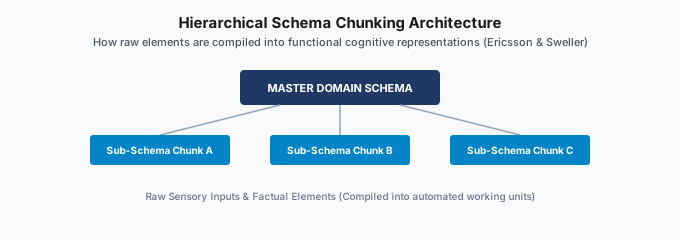
In cognitive science and expertise literature, a mental representation is an internal cognitive structure pre-encoded in long-term memory that corresponds to external objects, abstract concepts, systems relationships, or behavioral sequences. First popularized in peak performance research by K. Anders Ericsson and Robert Pool (2016) and grounded in cognitive architecture by Ericsson and Walter Kintsch (1995), mental representations are the foundational mechanism that enables expert human performance.
While novices perceive a complex situation as an overwhelming flood of disconnected sensory details, experts perceive reality through pre-built structural models. A mental representation is not a passive mental picture or a memorized snapshot; it is a dynamic, multidimensional cognitive framework. It allows the expert practitioner to:
- Encode Information Instantly: Grouping chaotic situational data into meaningful, organized configurations.
- Simulate Trajectories: Mentally running “what-if” simulations to anticipate how an adversary will react, how a surgical cut will affect tissue, or how a software system will scale.
- Guide Action with Real-Time Feedback: Serving as an internal reference standard against which real-time execution is continuously compared and corrected.
Whether in music, chess, aviation, cardiology, or computer science, the defining difference between an amateur and an elite expert is the sophistication, breadth, and fidelity of their mental representations.
How do mental representations help experts?
The practical benefits of well-developed mental representations manifest across four essential cognitive operations:
1. Rapid Perceptual Chunking
Human working memory is notoriously constrained, capable of processing only about four novel items simultaneously. Experts bypass this bottleneck by consolidating thousands of related data points into single cognitive units, or “chunks.” As documented in cognitive research on chunking in chess experts, grandmasters do not hold dozens of isolated chess pieces in mind; they perceive functional constellations (such as pawn structures or attacking formations), treating each complex tactical cluster as a single working-memory element.
2. Long-Term Working Memory (LTWM)
In their seminal 1995 paper, Ericsson and Kintsch proved that experts develop specialized retrieval structures that effectively link short-term working memory directly to vast reservoirs of long-term storage. This enables master performers to hold massive, complex situational models accessible in working awareness without succumbing to cognitive overload.
3. Principled Planning and Forward Reasoning
Novices solve problems through backwards trial and error, guessing at formulas because they cannot visualize the underlying physical dynamics. Experts use mental representations to build qualitative models first. They identify governing physical laws, eliminate unpromising moves before calculating them, and reason forward directly toward the optimal solution.
4. Metacognitive Error Detection
When a beginner plays an incorrect note on an instrument or introduces a syntax error in code, they rarely notice until someone points it out. Because experts possess an exquisitely detailed internal representation of what perfect execution sounds or looks like, they detect micro-deviations in real time, correcting posture, timing, and strategy before mistakes compound.
What does the research show?
The empirical validation of mental representations spans more than half a century of rigorous cognitive and educational investigations:
- The Chess Foundations: Pioneered by Adriaan de Groot (1965) and formalized by Chase and Simon (1973), memory trials revealed that masters could reconstruct complex game boards after a five-second glance with 90% accuracy, compared to 20% for novices. When pieces were arranged randomly without tactical meaning, the masters’ recall collapsed to novice levels. This proved that superior memory is not a general trait, but the product of domain-specific chunking structures.
- Template Theory: Fernand Gobet and Herbert Simon (1996, 1998) refined chunking models into Template Theory. They demonstrated that experts possess mental templates—schematic patterns consisting of a core invariant structure with flexible “slots” that can rapidly accommodate novel situational variables.
- The Prior Knowledge Meta-Analysis: In a definitive meta-analysis synthesizing 344 independent samples, Simonsmeier and colleagues (2022) examined the quantitative relationship between internal domain-specific knowledge representations and subsequent learning outcomes. They established that prior knowledge structures strongly predict future learning ($r \approx 0.40$ to $0.50$). An individual’s existing mental representations dictate how effectively novel information can be understood, integrated, and retained.
How can you build mental representations?
Mental representations cannot be acquired passively through listening to lectures or skimming textbooks. They are forged through deliberate cognitive exertion. Cognitive science validates five primary instructional strategies to build rich internal models:
- Deliberate Practice with Immediate Feedback: The most powerful engine for building representations is the evidence-based deliberate practice explained routine. Practice must occur at the boundary of current capability, where error signals force long-term memory schemas to restructure and adapt.
- Studying Expert Worked Examples: For novices, attempting unguided problem solving saturates working memory with means-ends search. Studying step-by-step worked examples created by experts allows beginners to focus all available cognitive capacity on analyzing structural relationships and extracting the underlying schema.
- Generative Drawing and Spatial Modeling: When learning complex scientific, anatomical, or technical systems, generating spatial diagrams forces deep integration between text and visual representations. A meta-analysis of 64 studies by Cromley and colleagues (2020) demonstrated that drawing diagrams produces significant comprehension advantages ($g = 0.35$) over reading alone, provided learners explicitly reconcile their drawings with the text’s core causal concepts.
- Self-Explanation and Mechanistic Questioning: As you encounter new case studies or problem sets, continuously prompt yourself with “Why does this step follow from the previous one?” and “What would happen to the system if this component failed?” Generating causal explanations transforms static facts into functional mental simulations.
- Dynamic Video and Simulation Scaffolding: For complex procedural or physical systems, studying segmented animations with interactive pacing controls builds temporal mental models far more effectively than static text descriptions ($g = 0.34$ to $0.65$).
To adopt a comprehensive, field-tested training architecture that guides you through building professional-grade mental representations across complex disciplines, explore the skill system.
What mistakes should you avoid?
Learners frequently subvert their cognitive development by falling into predictable representational errors:
- Mistaking Verbal Memorization for Structural Comprehension: Reciting textbook definitions is not a mental representation. If you cannot explain the mechanism in your own words, draw a functional schematic, or apply the principle to a novel scenario, you possess mere verbal trivia rather than a usable internal model.
- Practicing in the Absence of Error Feedback: Practicing without an objective feedback loop cements flawed representations. Once an incorrect mental habit is automated, unlearning it requires double the practice time.
- Ignoring Edge Cases and Anomaly Training: Novices practice only routine, standard scenarios. Elite expertise requires deliberately exposing your mental models to bizarre edge cases, systemic failures, and unusual variations, testing the boundary limits of your internal representations.
How are mental representations related to schemas and chunks?
In cognitive psychology, the terms representation, schema, and chunk are closely related concepts that operate at different levels of architectural abstraction:
- A Chunk: The smallest functional unit of organized memory. A chunk groups lower-level perceptual stimuli into a single recognizable pattern (e.g., recognizing the letters C-A-T as a single word, or recognizing a tactical knight fork in chess).
- A Schema: An organized framework of interrelated concepts and rules stored in long-term memory. As explored in our deep dive into what is a schema in psychology, schemas provide expectations, default attributes, and procedural guidelines for interpreting reality.
- A Mental Representation: The macroscopic, dynamic orchestration of multiple interrelated schemas, chunks, and retrieval structures that allows a human being to perceive, simulate, and manipulate complex reality in real time.
Can anyone build expert-level representations?
Yes. While individual differences in working memory capacity and processing speed influence how rapidly initial training progresses, the capacity to construct rich mental representations is an inherent biological attribute of the human brain.
Building expert representations does not require superhuman genetic gifts. It requires dedicating thousands of hours to structured, effortful practice: studying expert exemplars, generating causal explanations, and embracing immediate corrective feedback. To understand the long-term developmental trajectory required to cultivate these cognitive structures, explore our foundational guide on how experts develop.
References & Scientific Evidence
- (1993).The role of deliberate practice in the acquisition of expert performance.
- (2016).Peak: Secrets from the New Science of Expertise.
- (1995).Long-term working memory.
- (1973).Perception in chess.
- (1996).Recall of rapidly presented random chess positions is a function of skill.
- (2022).Domain-specific prior knowledge and learning: A meta-analysis.
- (2020).Drawing to learn: A meta-analysis of drawing compared with reading.
- (1981).Categorization and representation of physics problems by experts and novices.