How to Turn Books Into Usable Knowledge: The Cognitive Science of Active Reading

Why do we forget most of what we read?
Most readers experience a demoralizing cognitive phenomenon: after spending ten hours reading a rigorous nonfiction book, they find themselves unable to recall its primary thesis or apply its principles just two weeks later. They recognize the book’s ideas when someone else mentions them, but spontaneous, unprompted recall is absent.
This failure occurs because passive reading treats the book as an external hard drive rather than a prompt for cognitive reconstruction. As psycholinguist Falk Huettig demonstrates in The Perks of Being a Bookworm (2023), the human brain is not a recording device. The written word is an unnatural cultural invention that demands active, top-down neural recruitment. When readers passively scan text, highlight sentences, or consume digital summaries, they engage in surface-level recognition that bypasses long-term memory consolidation, producing an acute illusion of competence.
How do you translate a book into permanent mental models?
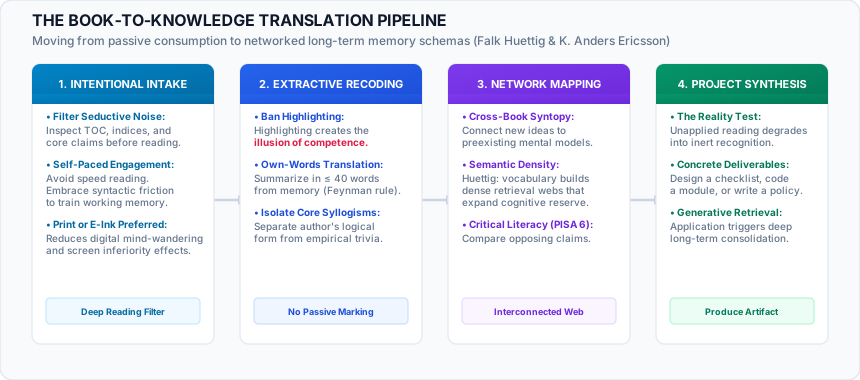
Turning a book into usable knowledge requires moving through a structured, generative four-phase pipeline: intentional intake, extractive recoding, network mapping, and external application.
1. Intentional Intake & Screen Superiority Safeguards
Before reading, inspect the table of contents, introduction, and index to establish an initial schema. Opt for print or e-ink formats whenever reading complex material. Cognitive meta-analyses highlight a consistent "screen-inferiority effect": reading on digital screens promotes superficial skimming, poorer metacognitive calibration, and higher rates of mind-wandering compared to physical paper.
2. Extractive Recoding: Banning the Highlighter
Highlighting text is among the least effective study habits in empirical cognitive science (Dunlosky et al., 2013). Highlighting creates a false feeling of mastery while requiring zero mental retrieval. Instead, enforce the closed-book translation rule: after completing a chapter, close the volume and write an extractive summary of no more than 40 words strictly from memory. This forces the brain to separate the author's logical structure from illustrative trivia.
3. Network Mapping & Semantic Density
Isolated facts decay quickly; interconnected networks persist. Huettig highlights that avid readers read up to 4 million words per year compared to 50,000 for non-readers, creating a massive Matthew Effect. This exposure builds dense, interconnected semantic webs that strengthen working memory manipulation (backward spans) and expand long-term retrieval cues. Connect new insights directly to preexisting mental models from other books.
4. Project Synthesis: The Reality Test
Knowledge left unapplied degrades into inert information. The ultimate test of reading comprehension is producing a tangible external artifact: code a software module, design a diagnostic checklist, draft an organizational policy, or synthesize competing arguments into an original essay.
How does lifelong book reading build cognitive reserve?
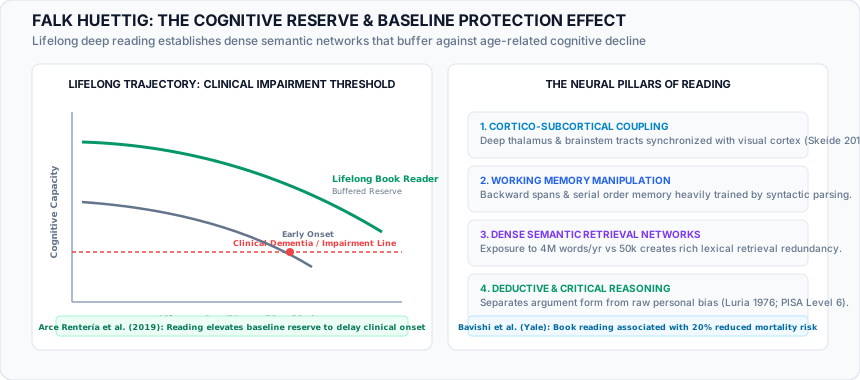
Beyond immediate learning goals, sustained deep reading physically transforms and preserves the biological brain. Longitudinal neuroimaging and epidemiological studies compiled by Huettig confirm the Cognitive Reserve Hypothesis: engaging in high-volume, syntactically complex reading builds an expansive neural buffer that defends against age-related cognitive decline.
The longitudinal evidence confirms three profound neurological protective effects:
- The Baseline Protection Effect: In the landmark Columbia University Aging Project (Arce Rentería et al., 2019), illiterate adults were three times more likely to develop dementia than literate peers. While reading does not stop the biological rate of neurological decline once pathology begins, it raises the baseline of cognitive functioning so high that clinical symptoms are delayed for years.
- Cortico-Subcortical Coupling: fMRI investigations (Skeide et al., 2017) prove that learning to read strengthens functional white-matter coupling between deep evolutionary subcortical regions (thalamus and brain stem) and visual cortex networks (V1–V4), optimizing visual search and attentional filtering.
- Survival and Longevity Advantages: A 12-year longitudinal study from Yale University (Bavishi et al., 2016) tracking 3,635 adults found that regular book readers lived an average of four months longer, exhibiting a 20% reduction in mortality risk compared to non-book readers.
How does text train decontextualized deductive reasoning?
Spoken conversation is rich with immediate context: tone of voice, facial expressions, and shared physical surroundings. Written language, by contrast, is completely decontextualized. As Soviet psychologist Alexander Luria (1976) discovered in his Central Asian expeditions, non-literate individuals struggle to evaluate formal syllogisms when the premises conflict with personal observation.
Reading complex "book language" forces the human brain to evaluate an argument's logical form independently of its empirical content. Written prose contains significantly higher frequencies of rare words, subordinate clauses, and long-distance syntactic dependencies than everyday spoken dialogue. Navigating complex texts (such as deciphering garden-path sentences) strengthens the central executive, improves backward digit span manipulation, and cultivates PISA Level 6 Critical Literacy—the ability to evaluate competing claims and detect structural bias.
What actionable habits maximize retention from books?
To convert reading from a passive pastime into an intellectual engine, implement these evidence-based study protocols:
- Pace for Meaning, Not Speed: Reject commercial speed-reading courses. Eye-tracking research proves that speed reading drastically reduces comprehension. Roughly 15% of natural saccades in proficient readers are regressions (re-reading difficult passages), which acts as a vital comprehension repair mechanism.
- Embrace Syntactic Friction: Avoid using AI summarizers to dilute challenging prose into bullet points. Encountering and resolving difficult sentence structures is the exact cognitive exercise that trains working memory and mental agility.
- Write Chapter Retrieval Tests: After finishing a reading session, draft two or three diagnostic questions based on the core mechanisms discussed. Schedule these questions in a personal flashcard deck or notebook for spaced retrieval over subsequent weeks.
- Build a Syntopic Concept Map: When reading multiple books on a single domain, do not store notes in isolated book-specific folders. Group concepts by theoretical problem (e.g., comparing how Geary, Deacon, and Huettig explain the origins of reading), organizing notes by concept rather than volume.
Should you read fewer books more deeply, or skim widely?
The optimal approach depends on your expertise within the domain. Beginners require high-volume, varied reading to build the basic vocabulary and semantic networks necessary to understand the field's terrain (exploiting the Matthew Effect).
However, once foundational schemas are established, reading fewer foundational texts with extreme analytical depth yields far higher returns. Deep reading that involves annotating arguments, mapping syllogisms, and producing external synthesis projects constructs robust, permanent mental representations that skimming dozens of superficial books can never replicate.
References & Scientific Evidence
- (2023).The Perks of Being a Bookworm: The Science of the Benefits of Reading.
- (2013).Improving students' learning with effective learning techniques.
- (2011).Retrieval practice produces more learning than elaborative studying with concept mapping.
- (2019).Illiteracy, dementia risk, and cognitive trajectories among older adults.
- (2016).A chapter a day: Association of book reading with longevity.
- (2009).Matthew effects in reading: Some consequences of individual differences in the acquisition of literacy.
- (1976).Cognitive Development: Its Cultural and Social Foundations.