How to Read for Learning: SQ3R, Active Reading and Retention

What does it mean to read for learning?
Reading for entertainment and reading for learning are cognitively distinct operations. When reading a narrative for pleasure, the brain tracks episodic storylines through bottom-up linguistic flow. Reading for learning, however, requires constructing a durable, abstract mental model of complex domain principles—a process that demands top-down executive attention and generative cognitive reconstruction.
In educational psychology, most student reading habits default to passive scanning: sweeping the eyes over printed pages, marking lines with fluorescent highlighters, and engaging in unspaced re-reading. Cognitive science demonstrates that these passive practices produce an intense illusion of competence: familiarity with the text is mistaken for mastery of the underlying ideas. Reading for genuine retention requires breaking this passive cycle by embedding active retrieval directly into the reading process.
How does the reading brain process text into meaning?
To understand why passive reading fails, we must inspect the computational architecture of literacy. In *Language at the Speed of Sight* (2017), cognitive scientist Mark Seidenberg outlines the Connectionist Triangle Model, which maps word reading as a distributed statistical network operating across three codes: Orthography (print), Phonology (mental sound), and Semantics (meaning).
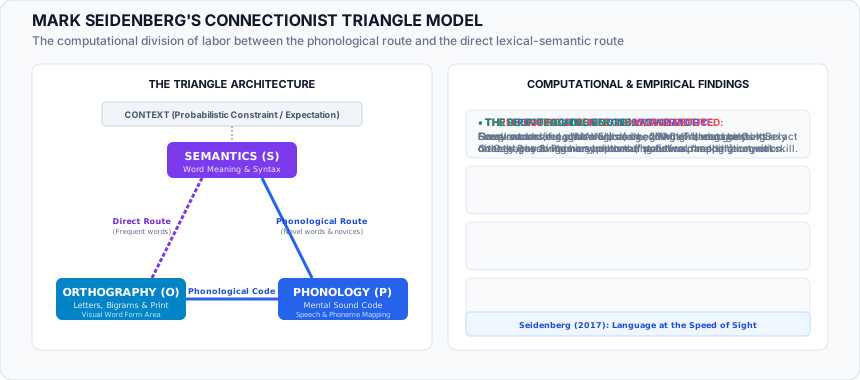
Seidenberg and Stanislas Dehaene establish four critical computational findings that govern how we read:
- The Dual-Route Division of Labor: The brain reads through two parallel pathways: the phonological route (Orthography $\rightarrow$ Phonology $\rightarrow$ Semantics), which decodes novel words and complex syntax, and the direct route (Orthography $\rightarrow$ Semantics), which automates familiar and irregular words.
- The Whole-Word Myth: Proficient readers do not recognize words as holistic pictures or silhouettes. High-speed eye-tracking proves that the Visual Word Form Area (VWFA) breaks printed words down into letter identities and bigrams in parallel within 200 milliseconds.
- Context Is Not a Decoding Crutch: The popular "three-cueing" educational model assumes good readers guess words from context. In reality, skilled readers recognize words automatically and use context only for semantic integration; poor readers guess from context because their bottom-up decoding is weak.
- The Self-Teaching Mechanism: Every time a reader actively decodes an unfamiliar word rather than skipping or guessing it, they strengthen the statistical connections between orthography, phonology, and meaning, permanently expanding their vocabulary network.
What is SQ3R and how do you execute it?
Formulated by educational psychologist Francis P. Robinson during World War II in *Effective Study* (1946), SQ3R is a structured five-step active reading protocol designed to prevent passive scanning: Survey, Question, Read, Recite, and Review.
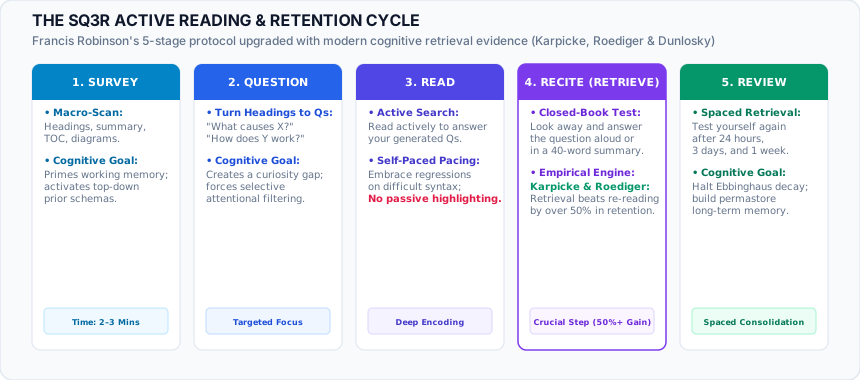
While SQ3R provides a classic defense against mindless skimming, modern cognitive architecture demands evolving beyond traditional linear reading steps. Effective readers treat text not as a chronological sequence of sentences to be transcribed, but as a territory for extractive non-linear synthesis and relationship mapping:
- Survey (2–3 Minutes): Before diving into chapter text, skim the introductory summary, major and minor headings, bold terms, diagrams, and concluding chapter questions. This primes the fronto-parietal executive network with a top-down macro-schema, identifying high-yield frameworks before details overload working memory.
- Question: Convert each heading into an active, inquisitive question before reading the section. For example, turn the heading "The Working Memory Bottleneck" into *"What specific capacity limits define the working memory bottleneck, and why does it constrain learning?"* This creates a curiosity gap that directs selective visual attention.
- Read (Extractive Structural Synthesis): Read the section actively with the explicit goal of answering your generated question. Instead of linear verbatim transcription or passive summarization, focus on identifying cause-and-effect mechanisms, hierarchies, and cross-concept links. Embrace regressions (re-reading difficult sentences) to resolve syntactic ambiguity, while strictly avoiding passive highlighting.
- Recite (Non-Linear Retrieval & Schema Mapping): The cognitive engine of the entire protocol. At the end of the section, look away from the text and construct a non-linear relationship sketch or concise conceptual summary strictly from memory. Map how this concept links to pre-existing knowledge. If you cannot explain the structural relationships without looking, you have not encoded it.
- Review: At the conclusion of the study session and across expanding intervals (after 24 hours, 3 days, and 1 week), test yourself on your questions and relational schemas without reviewing the answers first, halting the Ebbinghaus forgetting curve.
Does re-reading work, and what does the evidence show?
Re-reading is the most popular study method among students, yet empirical cognitive psychology demonstrates that it produces minimal long-term benefit. In a comprehensive review of study techniques, Dunlosky et al. (2013) rated re-reading as having low utility. Similarly, Callender and McDaniel (2009) demonstrated across multiple laboratory trials that a second reading of a textbook chapter produces negligible gains on deep comprehension and inference tests.
Re-reading fails because it is an entirely recognition-based activity. When reviewing highlighted text for the second or third time, the words are processed with high perceptual fluency: the brain recognizes the prose easily and assumes it has mastered the concept. However, recognition requires almost no neural retrieval effort. In contrast, generative retrieval practice (Roediger & Karpicke, 2006; Karpicke & Blunt, 2011) forces the brain to reconstruct memory traces from internal wetware, yielding over 50% higher long-term retention compared to repeated reading.
How do you protect the deep reading circuit in a digital age?
In *Proust and the Squid* (2007), cognitive neuroscientist Maryanne Wolf outlines the developmental trajectory of the reading brain across five stages—culminating in the Expert, Deep Reader.
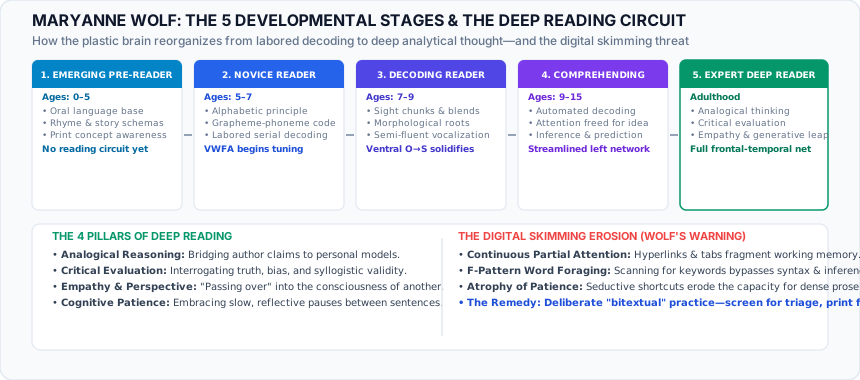
Wolf cautions that the deep reading circuit is culturally acquired and neurologically fragile. It is characterized by four time-demanding cognitive processes:
- Analogical Reasoning: Bridging the author’s concepts with pre-existing personal mental models to generate novel insights.
- Critical Evaluation: Interrogating the author's syllogistic premises, detecting unstated assumptions, and testing logical consistency.
- Empathic Perspective-Taking: "Passing over" into the consciousness and subjective experience of another mind.
- Cognitive Patience: Tolerating ambiguity and pausing between sentences to let internal reflections unfold.
The ubiquity of digital screens threatens this circuit. Digital environments encourage F-pattern skimming, keyword foraging, and continuous partial attention. When digital skimming becomes a reader's default mode, the capacity for sustained, deep analytical thought atrophies. Wolf advocates cultivating a "bitextual brain": deliberately using digital screens for rapid triage and keyword searching, while fiercely protecting distraction-free, print-based sessions for dense, transformative reading.
How do you remember what you read a week later?
To retain what you read beyond short-term memory, tie your reading directly to a spaced retrieval schedule. Close every reading session by generating two or three flashcards or test questions based on the core causal mechanisms of the chapter.
Rather than re-reading the chapter a week later, review only your self-generated questions and force your brain to retrieve the answers. Pair this retrieval with elaborative interrogation: ask yourself *why* the author's claim holds true and connect it to a concrete, real-world project. By combining the Recite step of SQ3R with spaced retrieval, you convert ephemeral reading into permanent, usable knowledge.
References & Scientific Evidence
- (1946).Effective Study.
- (2017).Language at the Speed of Sight: How We Read, Why So Many Can't, and What Can Be Done About It.
- (2007).Proust and the Squid: The Story and Science of the Reading Brain.
- (2009).Reading in the Brain: The New Science of How We Read.
- (2006).Test-enhanced learning: Taking memory tests improves long-term retention.
- (2009).The limited benefits of rereading educational texts.
- (2013).Improving students' learning with effective learning techniques.