Why Reading, Writing and Math Feel Hard: Learning What We Didn't Evolve For
Why do reading, writing and mathematics feel so hard?
Every healthy human child learns to speak their native language, recognize human faces, and navigate physical terrain effortlessly without a curriculum, flashcards, or formal instruction. Yet when that same child enters formal schooling to learn reading, writing, and arithmetic, the process often triggers tears, intense cognitive fatigue, and academic frustration.
This struggle does not reflect a biological defect or individual cognitive failure. Rather, it exposes a fundamental evolutionary discontinuity: the human brain underwent hundreds of thousands of years of natural selection to acquire biologically primary survival competencies, but written literacy and symbolic mathematics were invented only a few thousand years ago. In evolutionary terms, 5,000 years is a momentary flash—insufficient time for natural selection to evolve dedicated "reading modules" or "algebra organs." Academic mastery requires the brain to forcefully rewire older sensory circuits through deliberate, effortful practice.
How does the symbolic threshold explain cognitive resistance?
In *The Symbolic Species*, evolutionary anthropologist and neuroscientist Terrence W. Deacon uncovers the semiotic root of academic struggle. Drawing on C. S. Peirce's logic, Deacon demonstrates that human learning operates across three nested interpretive tiers: icons (perceived similarity), indexes (physical correlation or temporal co-occurrence), and symbols (systemic tokens defined by relationships to other tokens).

Animals and human infants are extraordinarily efficient indexical learners; they readily associate smoke with fire, or a spoken sound with an immediate object. However, symbolic systems operate on an unnatural, counter-intuitive architecture:
- Relational, Not Referential: Symbols do not map directly to physical things in isolation; they represent each other within an organized matrix of rules, substitutions, and exclusions. In algebra, "$x$" is not a concrete object; it is an abstract position defined solely by its operational relationship to "$y$" and "$z$".
- The Reverse-Learning Hurdle: Learning symbols requires the brain to unlearn or suppress the very indexical associations that make ordinary learning fast. Learners must build token-object pairings as stepping stones, and then subordinate those correlations so the formal token-token grammar controls meaning.
- The Prefrontal Choke Point: Discovering a closed combinatorial system requires holding numerous conflicting associations in working memory simultaneously. The disproportionately expanded human prefrontal cortex (PFC) must actively inhibit seductive indexical guesses (such as reading by visual shape guessing rather than phonetic decoding), producing intense cognitive strain.
What are biologically primary and biologically secondary abilities?
In his foundational framework for evolutionary educational psychology, David C. Geary (2007, 2024) formulated the critical boundary separating what human minds acquire naturally from what requires structured schooling.
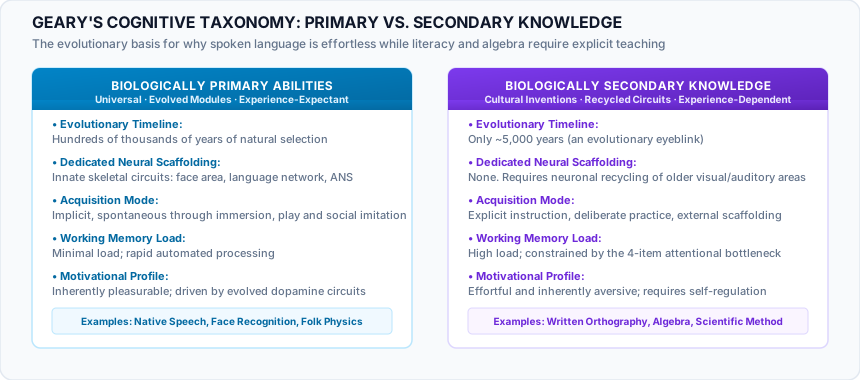
Geary divides human knowledge into two distinct biological categories:
- Biologically Primary Knowledge: Evolved adaptations organized around ancestral folk domains—folk psychology (social cues, facial processing, spoken language), folk biology (classifying flora and fauna), and folk physics (intuitive mechanics, spatial orientation). These emerge automatically through experience-expectant immersion, free play, and peer socialization. They are accompanied by inherent dopaminergic reward pathways that make engagement deeply pleasurable.
- Biologically Secondary Knowledge: Evolutionarily novel cultural competencies—such as alphabetic reading, compositional writing, and formal calculus. Because no dedicated neural architecture evolved to handle them, secondary skills are experience-dependent. They lack intrinsic motivational biases, depend entirely on top-down executive attention, and impose intense cognitive load on working memory.
How does the brain learn to read through neuronal recycling?
Because humans possess no native "reading gene," how does visual literacy physically occur in the biological brain? Cognitive neuroscientist Stanislas Dehaene and Laurent Cohen (2007, 2009) resolved this puzzle through the Neuronal Recycling Hypothesis. Literacy does not create new cortical tissue; it invades and repurposes preexisting brain circuits that evolved for entirely different visual functions.
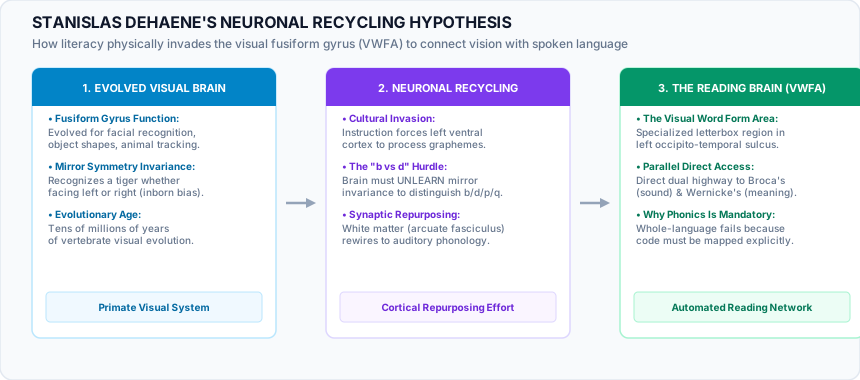
To acquire literacy, the brain must overcome three biological hurdles:
- Cortical Hijacking: Instruction repurposes the left occipito-temporal fusiform gyrus—a region originally evolved for recognizing animal tracks, predator silhouettes, and tools—transforming a specific sub-region into the Visual Word Form Area (VWFA), or the brain's "letterbox."
- Suppressing Mirror Invariance: Primates evolved "mirror symmetry invariance"—a tiger is equally dangerous whether facing left or right. However, alphabetic literacy demands that the brain actively suppress this ancient bias to distinguish asymmetrical graphemes such as b, d, p, and q. This explains why virtually all young children reverse letters during early reading.
- Bridging Vision to Phonology: Reading requires constructing dense white-matter tract highways (the arcuate fasciculus) linking the newly repurposed visual letterbox directly to ancestral auditory speech networks (Broca's and Wernicke's areas). This biological reality proves why progressive "whole-language" immersion fails and why explicit, systematic phonological decoding is biologically mandatory.
Why does mathematics require explicit instruction?
Human beings are born with an innate mathematical intuition known as the Approximate Number System (ANS), housed in the bilateral intraparietal sulcus. The ANS provides a rapid, intuitive sense of relative quantity—enabling infants and foraging primates to distinguish a large berry patch from a small one.
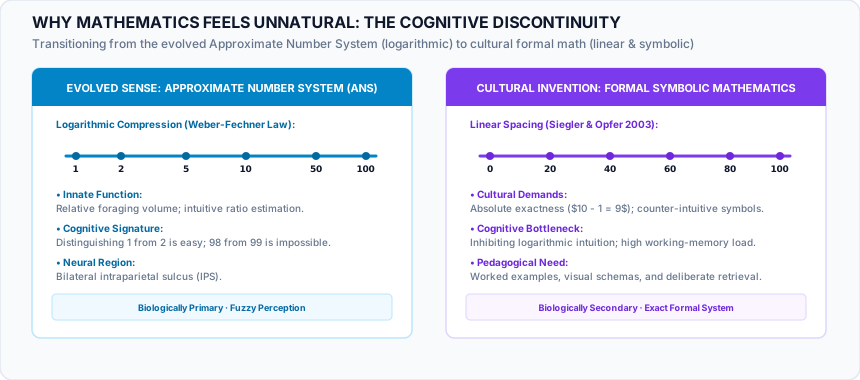
However, the ANS operates on an evolved logarithmic scale governed by the Weber-Fechner law: distinguishing 2 items from 4 items is effortless, but distinguishing 98 from 100 without counting is biologically impossible. Modern mathematics requires exactness ($10 - 1 = 9$, never "approximately 9"). As Robert Siegler and Julie Opfer (2003) demonstrated, children must undergo an effortful cognitive shift, overriding their intuitive logarithmic mental number line to build an abstract, evenly spaced linear scale.
Furthermore, symbolic algebra and abstract mathematics directly violate evolved folk physics intuitions. The human brain naturally searches for physical, tangible references; an algebraic formula ($x + y = z$) is relational, referencing symbols through other symbols. Mastering this abstract syntax requires heavy working memory suppression of intuitive biases, which explains why unguided discovery in mathematics consistently fails beginners.
What practical principles help overcome the evolutionary mismatch?
Recognizing the evolutionary origins of academic difficulty leads to actionable instructional design principles for educators and adult self-directed learners:
- Respect the Working Memory Bottleneck: Because biologically secondary knowledge lacks evolved scaffolds, working memory acts as a strict 4-item choke point. Use worked examples, chunking, and step-by-step scaffolding rather than open-ended problem solving for novices.
- Suppress Seductive Indexical Shortcuts: For phonics, prevent learners from memorizing word shapes by silhouette; force explicit phoneme-grapheme decoding. In algebra, explicitly teach transformation and equivalence rules rather than rote numerical answers.
- Ground Secondary Ideas in Primary Scaffolds: Anchor abstract concepts in ancestral folk domains. Teach spatial geometry with physical manipulatives (folk physics), and frame historical or conceptual lessons through human narratives, moral conflicts, and character relationships (folk psychology).
- Regulate the Salience Network (Anxiety Shielding): Evaluative academic environments often trigger the amygdala's threat response. Math anxiety hijacks the fronto-parietal executive network, reducing the working memory capacity available for computation. Build psychologically safe, low-stakes practice routines to keep executive control online.
- Enforce Deliberate Retrieval Over Passive Review: Neuronal recycling requires repeated, high-fidelity co-activation to stabilize novel white-matter tracts. Replace passive re-reading with spaced retrieval practice and targeted feedback to automate secondary schemas into long-term memory.
Does the mismatch mean some people are naturally bad at mathematics?
When learners experience cognitive friction in mathematics, popular culture often attributes the struggle to a lack of "natural math talent." However, evolutionary psychology reframes this assumption. No human possesses a "natural gene for calculus"—every single individual must construct secondary mathematical schemas from scratch through neuronal recycling.
While individuals differ in fluid intelligence (Gf), working memory capacity, and processing speed, research demonstrates that apparent "math talent" in adults is primarily driven by accumulated crystallized knowledge (Gc), early automated number-line mapping, and high conscientiousness. When instruction provides structured scaffolding that respects working memory limits, the vast majority of learners successfully construct robust, automated secondary competencies.
References & Scientific Evidence
- (1997).The Symbolic Species: The Co-evolution of Language and the Brain.
- (2007).Cultural recycling of cortical maps.
- (2007).Educating the Evolved Mind: Conceptual Foundations for an Evolutionary Educational Psychology.
- (2024).The Evolved Mind and Modern Education.
- (2009).Reading in the Brain: The New Science of How We Read.
- (2016).Working memory, long-term memory, and instructional design.
- (2003).The development of numerical estimation: Evidence for multiple representations of numerical quantity.