Evolutionary Mismatch: What It Means for How We Learn Today

What is evolutionary mismatch?
Evolutionary mismatch occurs when biological traits that evolved to enhance survival in an ancestral environment become maladaptive or generate intense friction within a radically altered modern environment. Natural selection operates across geological timescales, shaping anatomical, neurochemical, and cognitive adaptations to ancestral habitats. When human technology and cultural institutions transform the daily environment faster than the genome can adapt, ancient biological mechanisms clash with modern demands.
In evolutionary biology and medicine, mismatch explains pervasive modern epidemics such as obesity and cardiovascular disease: an evolved taste preference for calorie-dense sugars and fats—vital for surviving famine on the Pleistocene savanna—leads to chronic disease in an environment of industrial grocery stores and sedentariness. When applied to education, evolutionary mismatch examines how the human cognitive architecture, shaped over hundreds of thousands of years for foraging and social survival, responds to the modern requirement of sitting in age-segregated classrooms to master abstract symbolic systems.
What does the evidence show about evolutionary mismatch in learning?
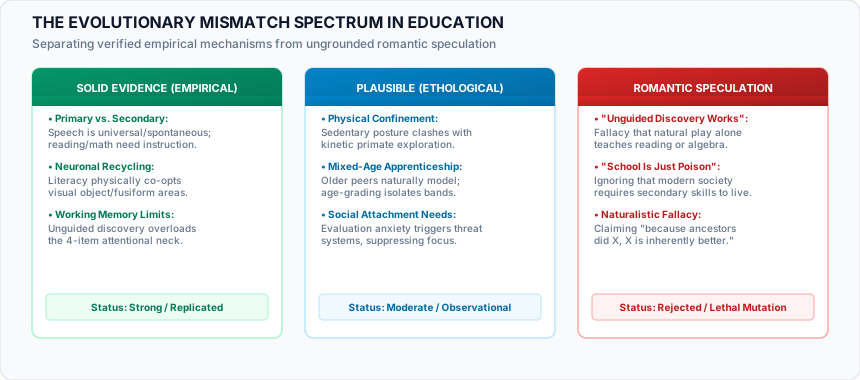
Applying evolutionary mismatch to learning requires analytical discipline. While evolutionary theory provides profound explanations for learner frustration, it is frequently co-opted by romantic educational fads. To understand its genuine implications, we must distinguish between validated cognitive science, plausible ethological observations, and speculative myths.
1. Solid Evidence (Cognitive Architecture & Recycling)
The most robust application of mismatch is David C. Geary's distinction between biologically primary and secondary knowledge. Humans evolved dedicated neural scaffolds for spoken language, face recognition, and intuitive mechanics. In contrast, reading, writing, and formal calculus are cultural inventions less than 5,000 years old. As cognitive neuroscientist Stanislas Dehaene has demonstrated, learning to read physically hijacks visual brain circuits through neuronal recycling, requiring sustained working memory attention and systematic phonics instruction.
2. Plausible Ethological Observations (Primate Classrooms)
Ethologists and evolutionary psychologists, such as J. Gary Bernhard and David F. Bjorklund, document clear mismatches between classroom physical environments and ancestral learning modes. Humans evolved to learn through kinetic movement, multi-age peer bands, and observational imitation of adult practitioners. Sedentary confinement and rigid age-segregation create demonstrable motivational and emotional friction.
3. Romantic Speculation & The Naturalistic Fallacy
The lethal mutation of mismatch theory is the romantic claim that because formal schooling is "unnatural," children can acquire reading, mathematics, and scientific thinking through unguided, "natural" discovery learning. As Paul Kirschner, John Sweller, and Richard Clark (2006) proved, biologically secondary disciplines cannot be discovered in a vacuum; unguided search overloads working memory and severely impairs achievement.
How does the modern classroom clash with primate ethology?
In *Primates in the Classroom* (1988), educational researcher J. Gary Bernhard documented how institutional schooling reverses ancient primate learning mechanisms. For millions of years across primate evolution and human foraging history, learning occurred within small, socially cohesive, mixed-age bands.
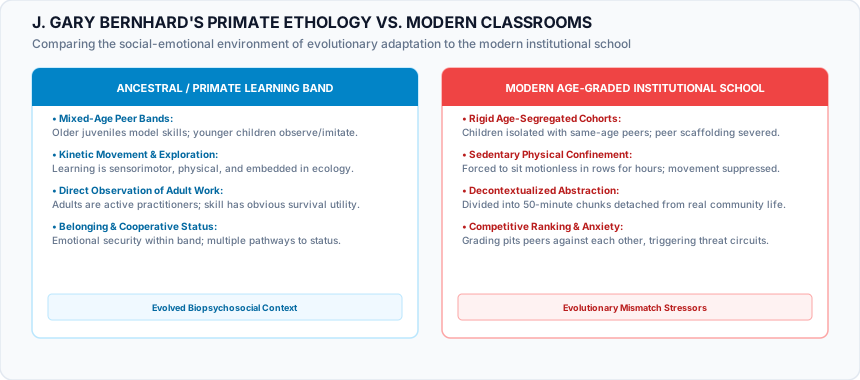
Bernhard identifies four severe structural mismatches in conventional schooling:
- Sedentary Confinement vs. Kinetic Play: Primates and ancestral human children learn about the physical world through hands-on tactile manipulation and continuous movement. Forcing children into stationary desks for six hours a day suppresses the sensorimotor feedback loops essential for spatial reasoning and engagement.
- Rigid Age-Banding vs. Mixed-Age Scaffolding: In ancestral groups, learning was intergenerational. Older children consolidated their knowledge by teaching younger juveniles, while younger children observed advanced peer models. Standardized age-segregation severs this natural apprenticeship dynamic.
- Decontextualized Abstraction vs. Visible Adult Work: Ancestral youth learned skills by observing adult members of their band perform vital community tasks (hunting, foraging, toolmaking). Modern classrooms isolate children from adult work, presenting academic exercises in arbitrary 50-minute chunks detached from visible utility.
- Institutional Dominance vs. Secure Social Attachment: In primate societies, learning occurs within secure emotional bonds and stable social status. The modern factory model of schooling relies on top-down institutional authority and competitive normative grading, which frequently activates the amygdala's threat system and impairs prefrontal working memory.
How can educators and self-directed learners bridge the mismatch?
Acknowledging evolutionary mismatch does not mean returning to the Stone Age or abolishing structured curricula. Instead, it provides a principled roadmap for cognitive engineering:
- Provide Explicit Structure for Secondary Knowledge: Accept that reading, coding, and mathematics are not natural. Do not leave learners to flounder in unguided discovery; provide worked examples, direct instruction, and step-by-step scaffolding.
- Reintroduce Mixed-Age Peer Mentoring: Structure study groups, coding bootcamps, and classrooms so that advanced learners mentor beginners, restoring the natural primate peer-modeling loop.
- Incorporate Kinetic Movement & Micro-Breaks: Break sedentary study sessions with active breaks and physical manipulation. Evolved brains consolidate abstract schemas far more effectively when physical movement periodically resets executive attention.
- Frame Secondary Skills Through Primary Folk Narratives: Anchor abstract theories in evolved social instincts. Use storytelling, historical conflicts, and collaborative group missions to make abstract problems socially meaningful.
Does evolutionary mismatch mean modern schooling is unnatural and bad?
No. Claiming that schooling is "bad" simply because it is evolutionarily novel is a textbook example of the naturalistic fallacy (the erroneous belief that what is natural is good, and what is unnatural is harmful). In nature, illiteracy is natural; famine is natural; infant mortality is natural.
Modern formal schooling is one of humanity's greatest cultural triumphs. It is an intentional cultural prosthetic designed precisely to bridge the vast chasm between our ancestral folk intuitions and the advanced, highly specialized knowledge required to sustain modern civilization. The goal of evolutionary cognitive science is not to dismantle schools, but to align their pedagogical methods with the biological contours of the human mind.
References & Scientific Evidence
- (2011).Evolutionary mismatch and what to do about it: a prospectus.
- (2007).Educating the Evolved Mind: Conceptual Foundations for an Evolutionary Educational Psychology.
- (1988).Primates in the Classroom: An Evolutionary Perspective on Children's Education.
- (2007).Evolutionary developmental psychology and the role of cognitive immaturity.
- (2006).Why minimal guidance during instruction does not work.