Metacognition: What It Is, Types and Examples in Learning

What is metacognition?
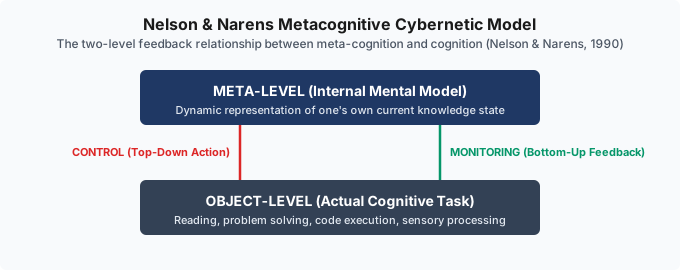
Metacognition is commonly defined as “cognition about cognition” or “thinking about one’s own thinking.” First formally introduced into developmental psychology by John Flavell in 1979, metacognition encompasses two interrelated components: the knowledge you possess about your own cognitive processes, and the active regulatory mechanisms you use to monitor and control those processes during learning.
To operationalize how metacognition functions, cognitive scientists Thomas Nelson and Louis Narens (1990) formulated a widely accepted two-level cognitive architecture:
- The Object-Level: Where ongoing cognitive processing occurs—such as reading a text, calculating a mathematical derivation, or recalling foreign vocabulary words.
- The Meta-Level: A higher-order supervisory system containing a dynamic mental model of the object-level. The meta-level receives diagnostic information from below via monitoring (evaluating how well you understand the text) and sends directional instructions back down via control (deciding to slow down, re-read a confusing sentence, or change study strategies).
In everyday academic and professional practice, applying metacognitive strategies determines whether a learner passively consumes information or actively guides their cognitive system toward durable, verified comprehension.
What are the types of metacognition?
Cognitive and educational psychologists divide metacognition into two primary functional categories, each subdivided into specific cognitive sub-components:
1. Metacognitive Knowledge (Knowledge of Cognition)
This refers to what learners know about human cognition in general and their own mental characteristics in particular. It consists of three knowledge dimensions:
- Declarative Knowledge: Knowing what factors influence your cognitive performance (e.g., knowing your working memory limits, recognizing that fatigue degrades focus, or knowing that retrieval practice outperforms re-reading).
- Procedural Knowledge: Knowing how to execute specific cognitive strategies (e.g., knowing how to construct a concept map, how to write elaborative flashcards, or how to isolate variables in an equation).
- Conditional Knowledge: Knowing when and why to apply a specific strategy over another. Cultivating conditional knowledge enables you to match specific cognitive tools to specific domain demands—for instance, choosing interleaved practice for problem-solving discrimination while using spaced retrieval for factual retention.
2. Metacognitive Regulation (Regulation of Cognition)
This refers to the active, real-time management of cognitive activity throughout a learning task:
- Planning: Setting concrete goals, selecting appropriate resources, estimating time requirements, and deciding on an initial operational approach before beginning study.
- Monitoring: Checking your comprehension and execution accuracy in real time (e.g., asking yourself whether an explanation makes sense while reading).
- Evaluating: Assessing the final outcome against initial standards after task completion, determining whether the learning goal was achieved and identifying what modifications are required for future tasks.
Why does metacognition matter for learning?
The capacity to accurately monitor and regulate your own learning is not merely a supplementary study skill; it is one of the strongest statistical predictors of academic and professional achievement.
In a comprehensive meta-analysis examining the relationship between metacognition, intelligence, and academic performance, Ohtani and Hisasaka (2018) synthesized data across diverse educational populations. Their findings demonstrated that metacognitive skills correlate substantially with academic performance ($r = 0.25$ to $0.35$), and critically, metacognition accounts for unique variance in learning success above and beyond general cognitive ability (IQ).
A companion meta-analysis by Dent and Koenka (2016) similarly confirmed that metacognitive monitoring and self-regulation consistently predict educational outcomes across childhood and adolescence. While a high baseline working memory capacity or processing speed provides raw cognitive power, metacognition acts as the executive steering wheel. An intellectually gifted student who lacks metacognitive regulation will waste hours on passive, low-utility study habits, while an average learner equipped with calibrated metacognitive monitoring systematically outperforms them by identifying comprehension gaps and applying high-leverage cognitive strategies.
What are examples of metacognition in studying?
Metacognition manifests across every phase of an authentic study workflow:
- Calibrating Judgments of Learning (JOLs): While reading a chapter on molecular biology, an unreflective learner assumes that because the sentences make sense, they have mastered the material. A metacognitively skilled learner pauses, closes the textbook, and attempts to explain the mechanism aloud. When they encounter difficulty, they immediately recognize that their initial judgment of learning was an illusion, directing their attention to the exact paragraphs that require remediation.
- Allocating Study Time Strategically: Research by Kornell and Bjork (2007) shows that novice learners often waste time practicing items they already know well because it feels emotionally gratifying. Metacognitively trained learners use objective self-testing data to route their time toward difficult, unmastered items, maximizing the return on study investment.
- Strategy Selection and Mid-Course Correction: When solving a complex coding problem, a metacognitive programmer continuously monitors progress. If an approach fails to yield results after fifteen minutes, they step back, evaluate whether their underlying assumptions are flawed, and deliberately switch to an alternative algorithmic model rather than doubling down on a broken implementation.
For professionals and self-learners striving to automate these cognitive routines into an independent study workflow, enrolling in a structured teach yourself course provides pre-built templates and reflective frameworks to systematize metacognitive habits.
Can you improve metacognition?
A critical question in cognitive education is whether metacognition represents a fixed personality trait or a teachable capability. Empirical intervention literature provides an unambiguous verdict: metacognitive skills can be explicitly taught, practiced, and substantially improved.
In an extensive meta-analysis evaluating self-regulated learning interventions across primary and secondary schools, Dignath and Büttner (2008) documented an impressive overall mean effect size of $d = 0.69$ for programs providing explicit metacognitive strategy training. Interventions that combined cognitive strategies (such as summarizing or elaborating) with explicit metacognitive reflection (prompting students to plan, monitor, and evaluate their own thinking) produced the largest improvements in academic performance.
Similarly, in adult workplace and corporate training environments, a meta-analysis by Sitzmann and Ely (2011) confirmed that prompting adult trainees to periodically reflect on what they know and plan subsequent study steps produced significant gains in skill acquisition and delayed retention ($d = 0.34$). Metacognition is not an innate genetic endowment; it is a learned executive discipline that develops through deliberate practice and continuous feedback.
How do overconfidence and miscalibration affect learning?
The single greatest enemy of metacognitive self-regulation is miscalibration—the statistical gap between a learner’s subjective assessment of their knowledge and their objective test performance. Human learners are naturally susceptible to severe overconfidence.
In a landmark experimental study, Dunlosky and Rawson (2012) investigated how students evaluate their own understanding of complex scientific definitions. When allowed to self-score their answers without an objective rubric, students dramatically overestimated their accuracy, rating incomplete or incorrect definitions as fully correct. Because they believed they had already mastered the concepts, they terminated their study prematurely. On delayed testing, these overconfident students exhibited severe underachievement compared to peers who received objective corrective feedback.
This cognitive disconnect is the engine behind the illusion of competence. When you read familiar notes or watch an engaging educational video, semantic processing feels fluent and effortless. The brain misinterprets this perceptual fluency as durable knowledge. Without closed-book retrieval testing, learners remain blind to their ignorance until an authentic exam or real-world problem exposes the deficit.
Is metacognition the same as intelligence?
Metacognition and general intelligence ($g$) are related cognitive constructs, but they are conceptually and functionally distinct.
Intelligence refers to raw cognitive processing capacity, working memory span, and abstract reasoning speed—attributes that are heavily influenced by genetics and relatively stable across adulthood. Metacognition, by contrast, represents knowledge and executive strategies regarding how that cognitive machinery is managed.
A learner can possess exceptional general intelligence yet exhibit poor metacognition—becoming arrogant, procrastinating, relying on superficial cramming, and dismissing corrective feedback. Conversely, an individual with average cognitive processing speed who exhibits rigorous metacognitive calibration—systematically breaking down goals, monitoring comprehension via active recall, and maintaining emotional discipline—routinely achieves superior long-term expertise. Intelligence determines how fast your engine can run; metacognition determines whether you keep the car on the road.
References & Scientific Evidence
- (1979).Metacognition and cognitive monitoring: A new area of cognitive–developmental inquiry.
- (1990).Metamemory: A theoretical framework and new findings.
- (2009).Metacognition.
- (2018).Beyond intelligence: A meta-analytic review of the relationship among metacognition, intelligence, and academic performance.
- (2016).The relation between self-regulated learning and academic achievement across childhood and adolescence: A meta-analysis.
- (2012).Overconfidence produces underachievement: Inaccurate self evaluations undermine students' learning and retention.
- (2008).Components of fostering self-regulated learning among students: A meta-analysis on intervention studies at primary and secondary school level.
- (2011).A meta-analysis of self-regulated learning in work-related training and educational attainment: What we know and where we need to go.